

WATCH NOW
Watch on the app














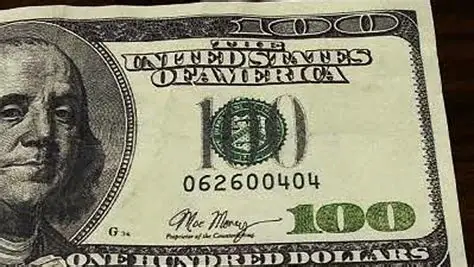
A $100 bill sold for $19,200 because of eight tiny numbers
-
Small fortune awaits thousands of everyday cash holders who double check the serial codes printed on their paper currency.
-
Heritage Auctions auctioneers record major price surges for pristine collectible bank notes carrying rare numerical sequences.
-
Financial experts recommend seeking professional grading services before spending or trading rare bill series.
Your $100 bill might be hiding a small fortune if its serial number looks like this upon inspecting the eight digits printed across its front face; furthermore, auction records from Heritage Auctions confirm that a 2017A series bill fetched $19,200 in 2024, which demonstrates how numismatic market research published by FinanceBuzz shows everyday citizens holding valuable currency without realizing it, as analysts advise checking both front corners while preserving leading zeros when reading serial codes authorized by the Federal Reserve System.
Additionally, Your $100 bill might be hiding a small fortune whenever unique mathematical patterns or low digits appear on the paper note; moreover, eBay online auctions documented a 2017 note carrying sequence 00000345 selling for $229, while historic 2013 notes featuring the 00000001 serial code exceeded $15,600 among private currency collectors.
Heritage Auctions:
“Rare currency notes with unique numerical combinations and pristine physical preservation consistently command top market valuations.”
Consequently, currency specialists advise protecting rare bills from folds and surface wear to maintain peak market value, while seasoned collectors urge individuals to request certified evaluations prior to completing any private sales transaction.
Collectible serial patterns commanding premium auction prices
Market transactions across leading auction platforms highlight distinct numerical combinations attracting intense collector interest; specifically, expert numismatists track eight unique numerical sequence categories across active public auctions, helping everyday cash holders identify potential treasures hiding in routine paper currency.
-
Complete solid series: Notes displaying eight identical numbers like 88888888 fetching up to $19,200 in top condition, though this same pattern can also appear on $1, $5, or on a Your $100 bill.
-
Technical series design: The initial letter of the serial code corresponds to the series year indicating when officials approved the design, not necessarily when workers printed the physical note.
-
Low numerical sequences: Serial combinations under 1,000 with leading zeros like the 00000002 note selling for over $3,000, offering collectors a chance to secure a small fortune.
-
Eight digit ladder notes: Consecutive ascending or descending sequences like the 1974 series carrying 23456789 selling for $4,600.
-
Replacement star bills: Special replacement notes where a 1950 star bill fetched $2,440, while a 1966 star note with a serial code under 1,000 reached $3,680.
-
Exclusive binary series: Serial patterns featuring only two unique digits like a 2017 note with six zeros and two ones selling for $1,440 in 2021.
-
Super repeater sequences: Patterns repeating two digit blocks like a 2006A series note with 02020202 bringing $900 at auction.
-
Super radar combinations: Serial numbers starting and ending with identical digits surrounding six matching numbers like 98888889 selling for $480.
-
Matching end blocks: Designs with matching three digit blocks or edge sequences like 15888815 trading for $300.
Loading video...Loading Video
Preservation practices and certified appraisal steps
Physical condition directly determines the final value of any collectible currency note; certainly, a single surface fold can sharply reduce the market value of rare currency, as seeing Your $100 bill highlighted in numismatic reports encourages people to inspect their wallet cash before making routine payments, so professional dealers recommend storing valuable notes inside rigid protective sleeves away from direct sunlight and humidity.
FinanceBuzz:
“The rarity of a numerical pattern combined with pristine physical preservation dictates the ultimate auction price for collectible paper currency.”
However, auction results reflect specific past sales rather than fixed guarantees for similar bill patterns; likewise, certified grading authorities establish official baseline valuations for rare paper note auctions, as Your $100 bill continues to offer surprising value within today’s currency market.
