

WATCH NOW
Watch on the app















Archaeologists uncover mysterious 476,000-year-old wooden structure that predates modern humans
-
Researchers reveal how prehistoric timber construction redefines early human capabilities as experts examine an ancient site in Zambia.
-
Luminescence dating of surrounding sand confirms that the logs rested undisturbed for nearly half a million years along a riverbank.
-
Advanced stone tools allowed early hominins to shape interlocking logs and build raised platforms above wet floodplains.
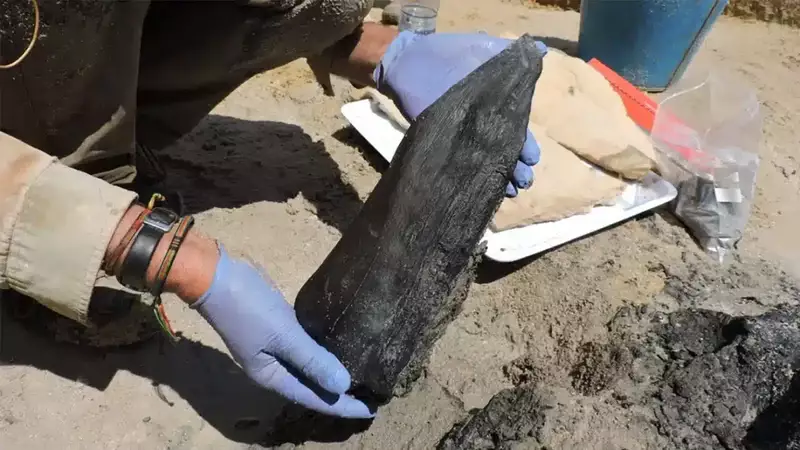
Before the earliest known fossils of our own species ever walked the earth, early hominins on a riverbank in Zambia crafted an interlocking timber framework using stone implements and now Archaeologists uncover this milestone discovery that predates modern humans by hundreds of thousands of years. Additionally, resting securely within waterlogged sand upstream from the towering 770 foot Kalambo Falls waterfall on the border between Zambia and Tanzania, two preserved tree trunks remain locked in place through a precisely notched structural joint.
Ver esta publicación en Instagram
Archaeologists uncover ancient stone tool carpentry
In 2019, a research team led by Larry Barham of the University of Liverpool described this monumental find in the journal Nature, while Researchers reveal that the upper log is a piece of bushwillow (Combretum zeyheri) measuring about 4.6 feet in length with tapered ends, resting on a larger tree trunk at a 75 degree angle where the upper log carries a U shaped notch 5.2 inches long and 4.5 inches wide cut across its grain, revealing under microscopic examination intentional chopping and scraping marks left by stone tools while the trunk underneath also prevents sideways movement and provides structural stability to the assembly.
Subsequently, because traditional radiocarbon dating cannot measure samples older than 50K years due to its absolute limit, co-author Geoff Duller and his colleagues at Aberystwyth University analyzed 16 sand samples using luminescence dating, which measures when mineral grains were last exposed to sunlight, yielding a mean age of 476K years for the deepest layers holding the logs with a margin of error of about 23K years, whereas correcting for a known signal loss in feldspar grains pushes this figure to about 554K years, meaning this extraordinary timeline eclipses previous wooden structural records while demonstrating how permanently high water tables prevented oxygen exposure and preserved organic materials.
Meanwhile, through ongoing research, Archaeologists uncover that the oldest known wooden structure before this find was only about 9K years old, whereas the oldest known wooden artifact of any kind remains a polished plank fragment from Gesher Benot Ya’aqov in Israel dating back more than 780K years, and furthermore, researchers already recovered wood from the site during the 1950s and 1960s, including a 5.4 foot log featuring a similar groove, although they lacked the precise dating and hand shaping proof available today.
Ver esta publicación en Instagram
Specialized wooden artifacts and raised platforms for wet environments
-
A specialized wedge: Archaeologists uncover that excavations yielded a carefully shaped wooden wedge designed to split or secure timber components with high precision using primitive implements.
-
An ancient digging stick: Researchers reveal that a recovered wooden shaft demonstrates early agricultural or foraging preparation techniques employed by hominins along the riverbank, highlighting early agricultural preparation methods.
-
Stepped chop mark logs: Experimental archeology confirmed that prehistoric woodworkers utilized quartzite cleavers to carve intentional steps into tree trunks for structural stability and support.
Environmental data links the preserved logs to an extensive forest cover period in the Kalambo basin lasting between approximately 470K and 274K years ago, suggesting that life on a periodically flooded riverbank featuring humid conditions exceeding 85 degrees Fahrenheit would have been significantly easier with a raised platform spanning over 150 square feet, a walkway or a foundation for shelters, as Researchers reveal through comprehensive stratigraphic analysis, while Annemieke Milks, an archaeologist at the University of Reading who did not participate in the study, noted that the site provides an important window into early human capabilities.
Structural breakthrough and an early forerunner of hafting
This structural arrangement points to a key technical breakthrough involving the combination of multiple parts into a single construction, serving as an early forerunner of hafting and demonstrating that these hominins actively altered their surroundings to create a functional built environment.
Researchers reveal unidentified hominin builders and prehistoric engineering
Without human remains recovered directly at the site, the builders’ identity remains open to interpretation, while Researchers reveal that Barham suspects Homo heidelbergensis, a human relative known to have lived from about 700K to 200K years ago under Pleistocene temperatures averaging 80 degrees Fahrenheit whose fossils appear elsewhere in Zambia, alongside Homo erectus as another candidate, and as Barham points out regarding our evolutionary assumptions, modern humanity often displays unwarranted arrogance by assuming that any complex intellectual achievement must exclusively belong to our own species.
Furthermore, as these historic relics prepare for their next chapter, Archaeologists uncover their enduring legacy, ensuring the recovered logs undergo professional conservation at the York Archaeological Trust in the UK before their permanent return to Zambia, where they will find a home at the Livingstone Museum as a permanent historical testament to early ingenuity.
Photo Credit: Larry Barham/University of Liverpool.
