

WATCH NOW
Watch on the app











Los Angeles earthquake made the San Andreas Fault the center of attention over fears of a bigger Big One
-
Shaking hits California on Friday and revives public alerts around the San Andreas Fault as residents watch regional seismic updates.
-
Local crews inspect city streets, buildings and utility lines after recent seismic activity across the southern and central regions.
-
Geologists track fault stress, aftershock patterns and regional seismic risks across the state while communities review safety plans.
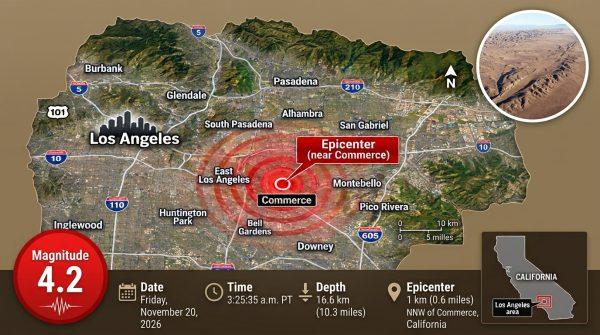
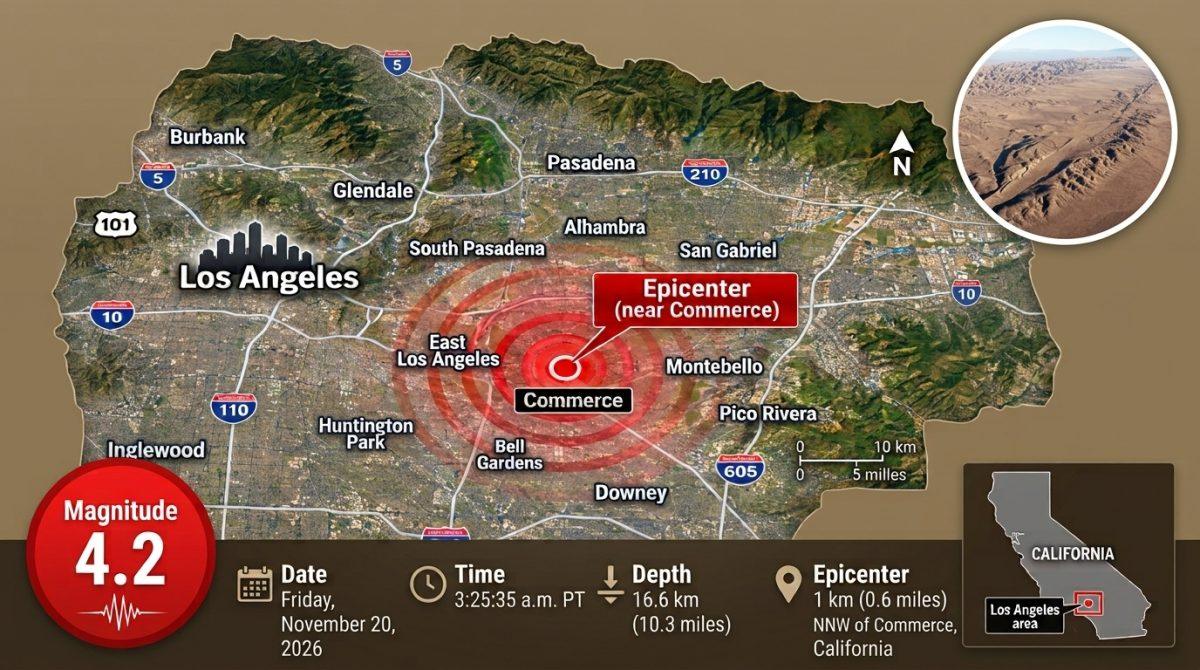
A Los Angeles earthquake made the San Andreas Fault the center of attention over fears of a bigger Big One on Friday, Nov 20, as residents felt ground shaking across southern and central California, municipal crews checked local structures across the basin, and neighbors tracked real time alerts from the United States Geological Survey to gauge how regional fault lines interact during active seismic sequences.
Furthermore, city leaders ordered preventive inspections across streets, buildings, and utility lines after officials logged a preliminary 4.2 tremor near Commerce in the Los Angeles area and a 5.0 quake near Pinnacles in central California, while early morning reports noted smaller shocks alongside the activity as crews checked homes and infrastructure and residents watched for aftershocks.
San Andreas Fault dynamics and recent seismic activity
The San Andreas Fault marks the boundary between the Pacific and North American tectonic plates across roughly 745 mi in California, where the Pacific plate shifts northwest relative to the North American plate and ongoing friction builds strain that releases as seismic waves, while early morning reports placed a preliminary 4.2 shock near Commerce and a 5.0 tremor near Pinnacles with smaller shocks.
Beyond that plate interaction, earth scientists explain that horizontal slip along this boundary differs from other tectonic zones where one plate slides beneath another, creating steady stress along California’s fault network while monitoring agencies tracked shaking felt across multiple districts and emergency teams ruled out major immediate damage.
Factors behind worries over a major Big One
-
The Big One refers to a severe earthquake scenario along sections of the San Andreas Fault or nearby faults that could strike densely populated areas home to millions of residents in California.
-
Geologists note that locked segments store strain for decades or centuries before slipping and damage severity depends on depth, exact location, and building strength.
-
Emergency managers urge residents to keep safety plans ready and review aftershock steps as recent shaking and fault shifts keep public focus on federal earthquake preparedness steps.
Past California earthquakes and their impact
-
The 1989 Loma Prieta quake struck near Santa Cruz with strong ground shaking that damaged Bay Area highways and bridges, plus structures across communities from Santa Cruz to San Francisco and Oakland.
-
The 1994 Northridge quake hit the San Fernando Valley with intense urban ground acceleration that damaged homes, parking structures and freeways across greater Los Angeles.
-
Recent sequences such as the 2019 Ridgecrest quakes in the Mojave Desert and the 2022 Ferndale tremor in northern California produced widespread shaking, ground cracks and utility checks across surrounding counties, showing how a Los Angeles earthquake or nearby rupture tests regional readiness.
Taken together, these past shocks show how fault ruptures test city infrastructure, guide building code updates and shape seismic monitoring across California.
Local response and ongoing monitoring
Moreover, the Los Angeles Police Department activated a damage assessment protocol instructing all units to inspect assigned zones alongside municipal crews and emergency teams checking roadways, structures and public services after the tremor, while engineers review retrofitted buildings, bridges, and water mains as researchers stress that steady scientific monitoring measures shifting ground activity without fueling baseless speculation.
Across California’s active terrain, Friday’s sequence keeps public focus on seismic readiness, structural resilience, emergency supply kits and aftershock safety guidance whenever a Los Angeles earthquake stirs fresh concern.