

WATCH NOW
Watch on the app















What if an asteroid were on a collision course with Earth? here’s how NASA plans to stop it
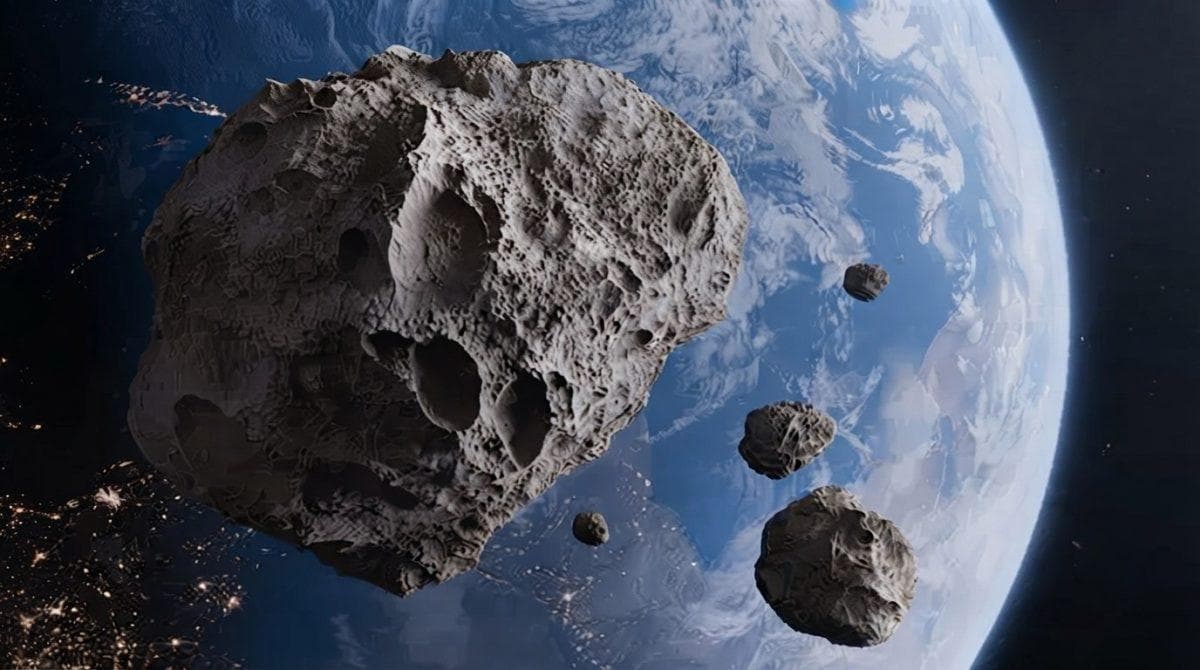
-
Space rock impact represents a constant concern for international scientific agencies monitoring the firmament, while asteroid collision Earth mobilizes global planetary defense protocols.
-
Astronomical experts evaluate celestial trajectories to prevent catastrophic risks across the planet.
-
Aerospace institutions develop advanced space interception technologies to guarantee the security of the global population against any cosmic threat.
Asteroid collision Earth mobilizes the international scientific, revealing that the National Aeronautics and Space Administration implements complex monitoring and defense systems to neutralize potential celestial threats before they pose an imminent danger to civilization; additionally, official reports from the Jet Propulsion Laboratory detail that 384,400 km typically separate Earth from nearby objects, although geological risks demand constant vigilance from space observatories.
This complex technological strategy transforms interplanetary security, forcing governmental agencies to coordinate global responses involving evacuation drills and kinetic deflection technology validated in prior missions; therefore, astrophysics specialists demand a massive investment in tracking infrastructure to guarantee the early detection of any rocky body on a collision course with terrestrial territory.
Ver esta publicación en Instagram
Advanced detection systems involving space rock impact and planetary defense
At the same time, aerospace engineers develop high-precision optical instruments to map the firmament and register over 30,000 objects orbiting silently in the immediate vicinity of the solar system; furthermore, the complexity of these space paths requires advanced computer algorithms that calculate exact trajectories decades in advance to prevent fatal surprises in global urban centers.
Moreover, historical data documented by space agencies proves that a massive space rock impact drastically altered Earth’s climate in remote epochs, compelling modern governments to finance massive prevention programs; nonetheless, budgetary constraints frequently delay the construction of new specialized telescopes, allowing small asteroids to pass unnoticed until they cross the lunar orbital limits.
Similarly, the absence of a natural defensive barrier in the outer atmosphere leaves densely populated regions vulnerable to large space rocks, forcing scientific consortia to prioritize the development of kinetic deflection technologies; consequently, experimental missions demonstrate that altering an asteroid’s orbit through controlled impacts provides a viable solution mathematically proven by researchers at the European Space Agency.
Essential protocols for asteroid collision Earth and mitigation
-
Utilization of infrared space telescopes to detect dark asteroids hidden by solar glare.
-
Deployment of kinetic impactor spacecraft to alter the trajectory of hazardous celestial bodies.
-
Coordination of global emergency response frameworks alongside civil protection agencies worldwide.
Meanwhile, independent audits backed by the Federal Emergency Management Agency endorse the effectiveness of adopting strict tracking controls to isolate celestial bodies where a space rock impact represents a latent threat before they cross the lunar orbit, ensuring that every monitoring phase meets the most rigorous standards of interplanetary security.
Future outlook for global space security
On another front, astrophysics experts emphasize that the modernization of orbital systems will determine the definitive success of these defensive missions, consolidating a safer exploration environment for future generations; however, authorities agree that preventing a space rock impact redefines international civil protection protocols by incorporating automated tracking systems and instant alerts for governments.
Consequently, leading agencies keep betting on the design of fully autonomous spacecraft to overcome terrestrial telescope limitations and guarantee the permanent protection of the planet, paving the way toward an era where orbital engineering rewrites the rules of human survival while scientists scan the horizon for any trace of asteroid collision Earth.
