

WATCH NOW
Watch on the app















This giant T. Rex fossil survived prehistoric battles, now it could fetch $30 million in NYC
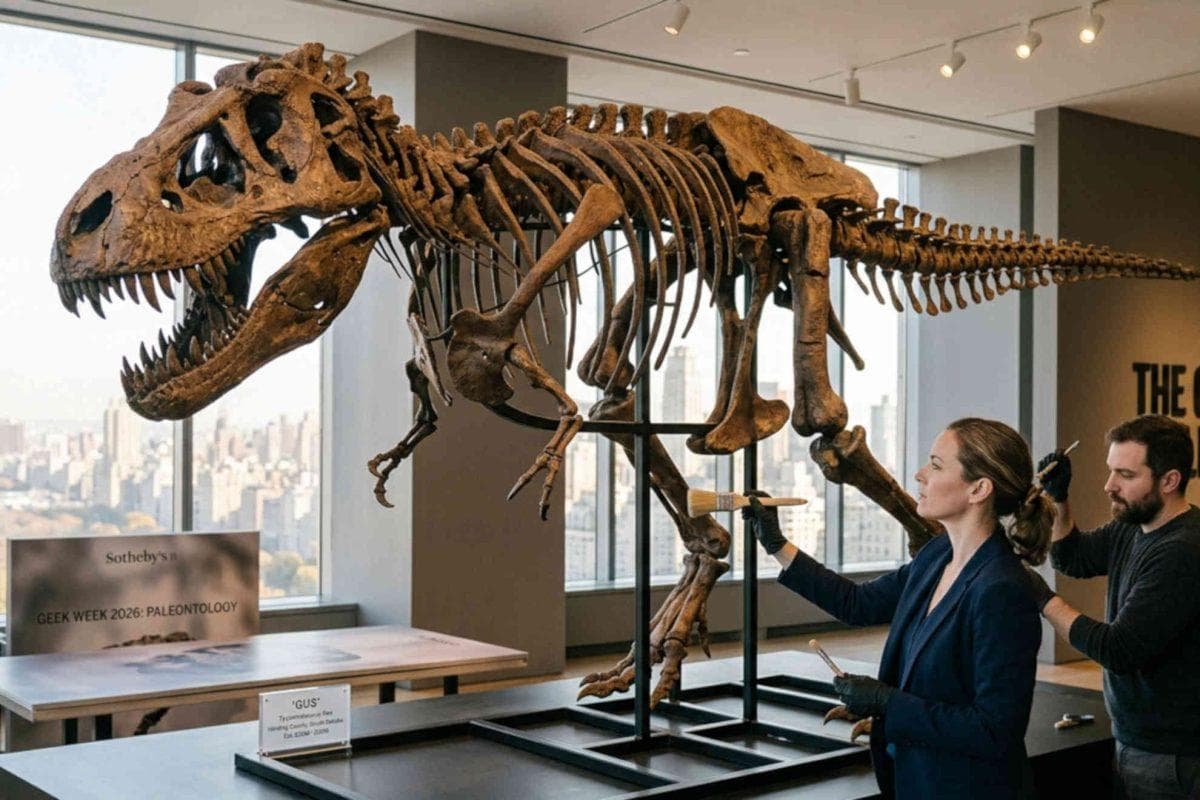
- Considered one of the most complete skeletons ever found in private hands, “Gus” will headline a historic auction at Sotheby’s.
- With 63% bone completeness and an amazingly preserved skull, this T. Rex stands out as a unique jewel for global paleontology.
- Combat marks found on its bones reveal a life of extreme survival during the Cretaceous, driving significant interest from collectors.
The imposing 67-million-year-old Tyrannosaurus Rex skeleton, nicknamed “Gus” by experts, prepares to headline a historic auction on July 14 at Sotheby’s in New York, where the final price should land between $20 million and $30 million; this impressive specimen reaches 11.5 meters in length and nearly 4 meters in height, and the public will see it starting in early July at The Breuer in Manhattan as part of the exclusive Geek Week lineup dedicated to historical science treasures.
Furthermore, the backstory of its discovery rivals the specimen itself in fascination, as Gary “Gus” Licking found the remains on his private ranch in South Dakota; after he identified fragments on his land, he allowed a team of paleontologists to start a meticulous excavation and reconstruction process that spanned several years.
The anatomical perfection of a super-predator
What truly elevates “Gus” above other paleontological finds remains its extraordinary level of preservation, since the fossil specimen gathers 183 bony elements representing approximately 63% of its body, a figure history only saw surpassed by two legendary specimens like “Sue” and “Stan”. Likewise, the animal’s skull retains 82% of its original bones along with complete dentitions, while its 128-centimeter-long femur surpasses the dimensions of other famous specimens, cementing it as a priceless scientific reference for evolution studies.
Beyond its massive size, this T. Rex preserves extremely rare anatomical pieces, including a complete pelvis, both humeri and the delicate furcula, elements that will allow researchers to delve deeper into the biomechanics and growth of the most powerful carnivores that once dominated the late Cretaceous, which explains why the New York auction will attract many high-profile bidders.
Signs of a violent life in the Cretaceous
Beyond its structural integrity, the fossil of this T. Rex named Gus stands out due to the indelible footprints of an existence marked by survival, evidenced by the various bite marks and healed fractures on its bones, which suggest fierce territorial combats the animal managed to overcome before its death.
These pathologies, documented on its ribs and the right dentary, turn the specimen into an authentic biological record, providing crucial information about the complex social interactions and constant dangers these predators faced in the wooded plains of what we now know as North America. Faced with the growing trend of international auctions like this one in New York, where fossils such as “Apex” reached record figures of up to $45 million, market experts trust that this piece will not only solidify itself as a multimillion-dollar investment for private collectors, but also as a fundamental link to understanding the legacy of the dinosaurs that once reigned over the planet.
