

WATCH NOW
Watch on the app















The myth collapses! NASA unveils the true interior of titan: From ocean to giant ice layer
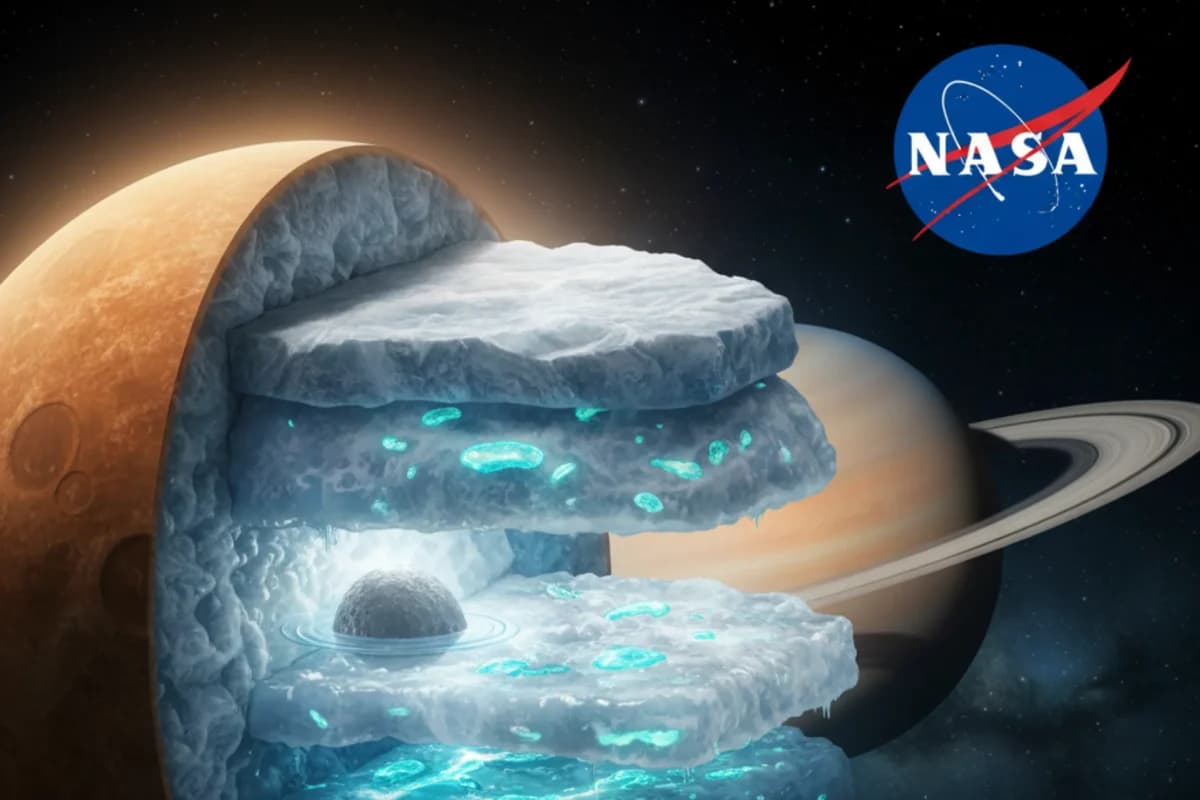
For almost twenty years, humanity believed that beneath the dense, mysterious atmosphere of Titan, Saturn’s largest moon, a vast water ocean lay hidden. This vision, which fueled our imagination about habitable worlds, has just been dismantled by a new and revealing study led by NASA. The discovery is surprising: instead of a global ocean, Titan harbors an immense layer of partially melted, warm ice.
This finding, derived from a new analysis of data from the Cassini probe (which orbited Saturn between 2004 and 2017), does not close the door to life; on the contrary, it multiplies the possibilities that life may exist!
Why Titan reacts late: The key to the ice
The scientific team noticed that the key to unmasking Titan’s interior lay in how the moon deforms.
-
The ocean theory: If Titan had a global water ocean, the gravitational force from Saturn would cause the satellite to deform almost instantly, like a pool of jelly.
-
The new reality: By applying advanced data processing techniques, scientists detected that the moon responds to Saturn’s gravity in an exaggerated way and with a significant delay.
Flavio Petricca, a NASA researcher and the study’s lead author, explained it graphically: “If you were standing on Titan’s surface and Saturn passed over your head, the ground beneath your feet would only start to rise about 15 hours later.”
The interior map: Slush and new possibilities for life
According to Petricca, this deformation delay is a clear indication that Titan’s interior is not made of an interconnected body of water but of a more complex composition:
“This is a strong indication that Titan’s interior is made of a slushy ice layer with widely distributed water pockets, and not a deep, interconnected global ocean.”
This is the first time scientists have managed to “square all the data with an exact model of Titan’s interior,” demonstrating the existence of much more complex and diverse extraterrestrial environments than previously thought. A world with partially molten ice and pockets of water opens up very interesting scenarios for astrobiology, where life, even in microbial forms, could find protected niches to thrive.
