

WATCH NOW
Watch on the app















Meteorites fall from the sky, the negotiator who sells them for thousands of dollars
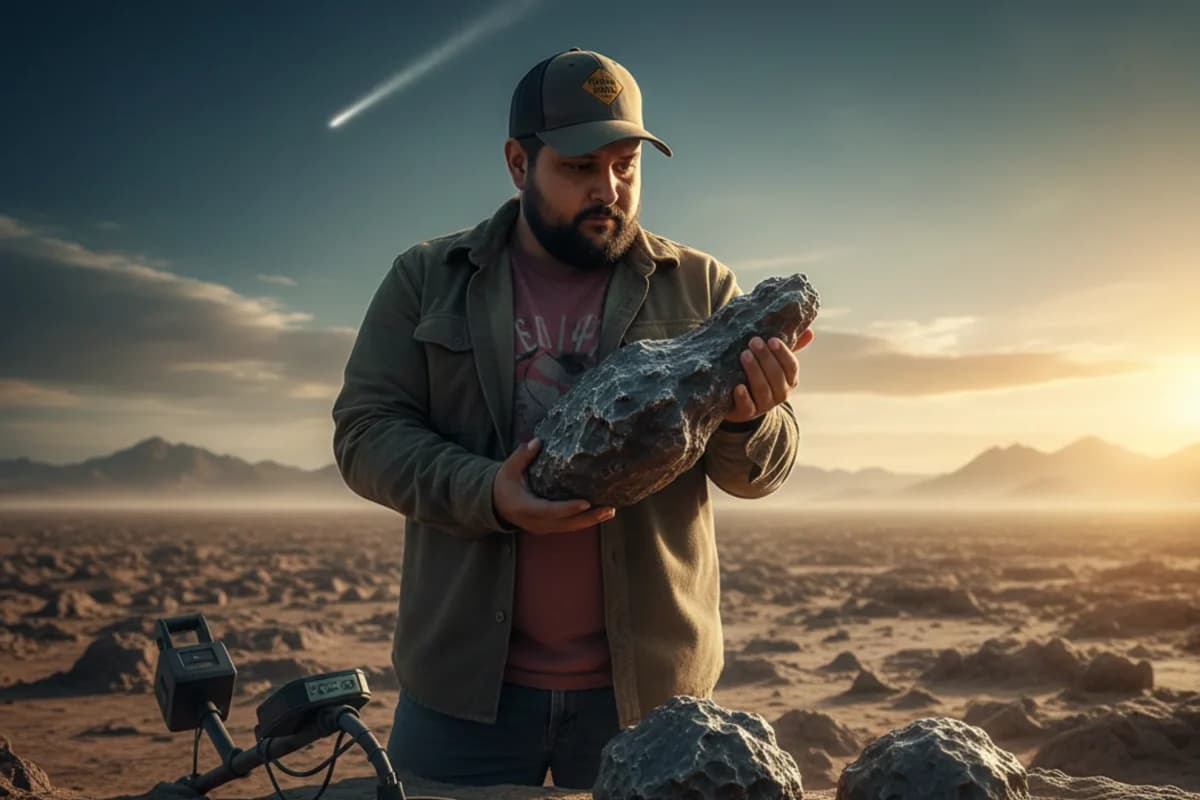
The phrase “money doesn’t fall from the sky” has become obsolete, at least for a select group of people who have found their gold mine by tracking rocks that do fall from space: meteorites. In recent years, a lucrative market has emerged where private collectors pay fortunes for a piece of extraterrestrial material, attracting professional hunters like Roberto Vargas. This American, the son of Puerto Rican immigrants, quit his job as a therapist to dedicate himself to traveling the world in search of these space treasures.
Vargas is clear: “As soon as something falls, it’s time to get going.” His story is not only one of economic success but of the curiosity that changed his life.
From collector to millionaire in one trip to Costa Rica
Vargas’s career began out of fascination, upon discovering that a “normal” person could own meteorites. His turning point came in 2019 when a meteorite fell in Costa Rica. Although he did not find the impact piece, he was able to buy several rocks, and the result of reselling them was surprising:
“I came back on a Friday [from Costa Rica] and by Monday I had already sold meteorites and had earned over US$40,000,” Vargas told the BBC.
Two years later, Vargas resigned from his steady job as a mental health therapist (where he earned between US$50,000 and US$60,000 a year) to dedicate himself exclusively to tracking these valuable space rocks, turning his passion into a profession.
The formula of value: What makes a rock worth millions?
The complexity of finding these space fragments is immense, but the value they reach is even greater. Meteorites (rocks that land on the Earth’s surface) can cost as little as 20 or 30 cents per gram, but unusual pieces can sell for millions of dollars. For example, a 24-kilogram Martian meteorite recently sold for US$4.3 million at auction.
Factors such as the size of the rock, the rarity of its composition (whether it comes from the Moon or Mars), whether it is a complete piece, and its provenance are key to setting its price. Professor Sarah Russell, an expert at the Natural History Museum in London, explains that to identify them, one must look for the “fusion crust,” a thin layer that forms when the rock melts upon entering the Earth’s atmosphere.
A business under scrutiny: Science vs. commerce
The trade of these rocks has generated a debate about who should own them. The auction of the Martian meteorite found in Niger raised controversy over the legality of the operation, given that regulations on heritage vary greatly by country.
Vargas defends the work of private finders, denying he is a “pirate”: “Yes, we have economic motivation, but also scientific. We want these rocks to be in the hands of scientists, and to be protected, cared for, and studied.” Furthermore, commerce encourages more people to search, which increases the samples available for study. Scientists note that, were it not for the private sector, it would be more difficult to obtain the most valuable pieces, which help us understand the origin of our solar system.
