

WATCH NOW
Watch on the app













Earth’s so-called ‘gateway to hell’ has tripled in size over 30 years
-
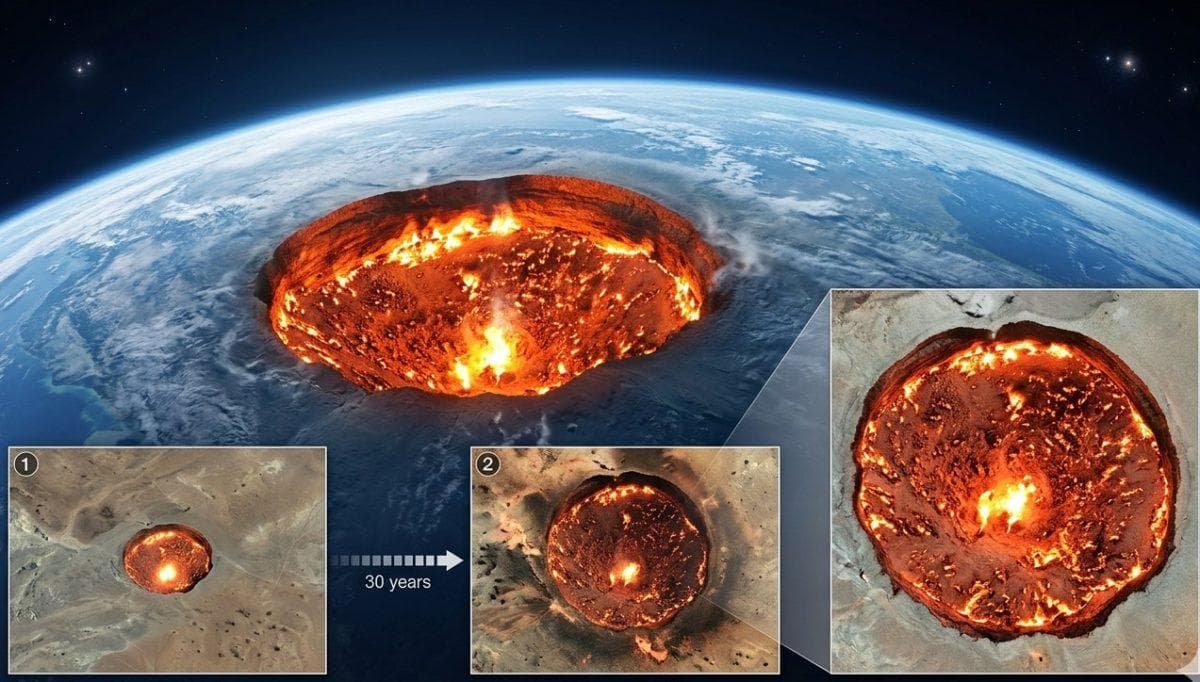
The Batagaika megaslump in Siberia, known as the Gateway to Hell, has grown exponentially, tripling its surface area over the last three decades.
-
The phenomenon results from the melting of permafrost, a process that releases greenhouse gases and reveals soil layers dating back 2.5 million years.
-
In addition to its scientific value, the crater serves as a source of local myths due to the underground rumbles it emits as the earth collapses.
In the far reaches of the Sakha Republic, in Russia’s Far East, a wound in the earth will not stop bleeding. While scientists technically refer to it as the Batagaika megaslump, the world knows it by a much more terrifying name, the Gateway to Hell. This colossal crater represents more than just a geological anomaly; in 2026, new measurements confirm that its size has tripled in barely 30 years, becoming a scar so vast that it is now fully visible from space.
The origins of an open wound
The history of this Gateway to Hell dates back to the Ice Age, when the ground remained sealed by permafrost (permanently frozen soil). However, human intervention in the 1960s, specifically massive deforestation, left the ground unprotected against sunlight. Without the shade of the trees, the terrain began to warm, initiating an irreversible thawing process known as thermokarst.
As the ice beneath the surface melts, the earth loses its support and collapses, creating an abyss that currently grows at a rate of up to 30 meters per year. What began as a small crack is today a natural amphitheater one kilometer long.
A 2.5-million-year window into the past
For the scientific community, Batagaika serves as more than a climate alarm signal. As the crater walls collapse, layers of sediment that have been frozen for millennia are exposed. This “natural laboratory” allows geophysicists to study plant remains and ecosystems that existed 2.5 million years ago, offering crucial clues about how Earth’s climate has changed in the past and what the future holds for us.
Sounds from the abyss: Reality and myth
For the local inhabitants of Yakutia, the phenomenon represents much more than a scientific curiosity. The nickname Gateway to Hell responds not only to its visual appearance but also to the “horrible” sounds emanating from its depths. Residents report hearing rumbles and noises similar to screams or gunshots.
Although science explains these noises as the result of the earth cracking as it fractures and the collapse of frozen soil layers, for those living nearby, the sounds serve as a constant reminder that the ground beneath their feet is disappearing.
A global climate threat
The expansion of the Gateway to Hell is a symptom of a much larger problem, the thawing of the Arctic. As the permafrost melts, enormous amounts of methane and carbon dioxide that had been trapped for ages are released. These greenhouse gases accelerate global warming, creating a vicious cycle that, in turn, speeds up the crater’s growth.
In 2026, Batagaika stands as a monument to the fragility of our ecosystem. It serves as a reminder that once the “gates” of the Arctic subsoil are opened, closing them remains a task that humanity does not yet know how to address.
