











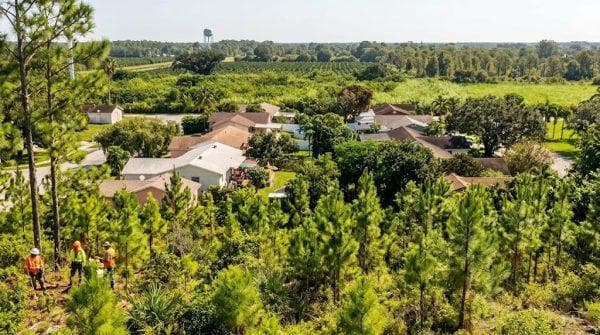


Florida is trading forests for neighborhoods and farmland at one of America’s highest rates
-
Neighborhoods and farmland rates experience drastic shifts across Florida as massive real estate projects aggressively convert native woodlands into urban infrastructure.
-
Environmental researchers rank the state fourth nationwide in total forest loss after clearing over 23,000 acres of natural canopy each year.
-
Conservation organizations closely monitor rapid urban expansion while the historic Florida Forever program faces severe budgetary cuts.
Environmental researchers at Clark University confirmed that Florida is trading forests for neighborhoods at highest rates, as satellite data analysis revealed the destruction of 658,000 acres of tree canopy across a 28 year timeframe; furthermore, scientists identified the region as a national hotspot for accelerated deforestation Scientific Reports.
Meanwhile, analytical land maps demonstrate that shifting landscape patterns alter environmental balances across multiple counties, given that commercial developers paved nearly 55% of former woodlands for residential complexes while agricultural operators converted the remaining 45% into farming soil; accordingly, northern counties suffered heavy losses from agricultural expansion, whereas southern jurisdictions directed nearly all cleared forest land toward intensive urban construction U.S. Environmental Protection Agency.
Florida is trading forests and changing local ecosystems
Geographic specialists at the School of Climate, Environment and Society explained that Neighborhoods and farmland rates shift significantly as natural forest recovery requires multiple decades of strict protection, prompting scientists to extend their satellite mapping research through 2025; admittedly, current trends indicate rapid habitat fragmentation despite a 2021 legislative act establishing the Florida Wildlife Corridor to connect nearly 18,000,000 acres, of which state agencies already manage 10,000,000 acres as public parks and protected reserves Florida Wildlife Corridor Foundation.
Subsequently, policy directors at 1000 Friends of Florida warned that the conservation corridor fails to reach southeastern counties, leaving vulnerable ecosystems exposed where legal conservation easements allow private landholders to retain property ownership while permanently waiving development rights; moreover, municipal planning boards designated nearly 1,100,000 acres within the corridor and another 3,000,000 acres outside its boundaries for future urban expansion by 2070, while historical programs like Florida Forever lost new state funding this year despite protecting 1,000,000 acres over its 26-year history 1000 Friends of Florida.
Mapping and projections on Florida deforestation
-
Historical loss metrics where Florida is trading forests: Comprehensive satellite surveys conducted between 1990 and 2017 place the state behind Georgia, North Carolina, and Texas in overall canopy depletion, recording a persistent loss exceeding 23,000 acres annually across the peninsula while research teams prepare updated datasets through 2025 U.S. Forest Service.
-
Conservation corridor goals: The 2021 legislation earmarked $2,000,000,000 in public funds to interlink 18,000,000 acres, incorporating 10,000,000 acres of existing public lands through land acquisitions and conservation easements where property owners maintain titles without developing the soil, successfully safeguarding 500,000 acres even though the network excludes southeastern regions State of Florida Legislature.
-
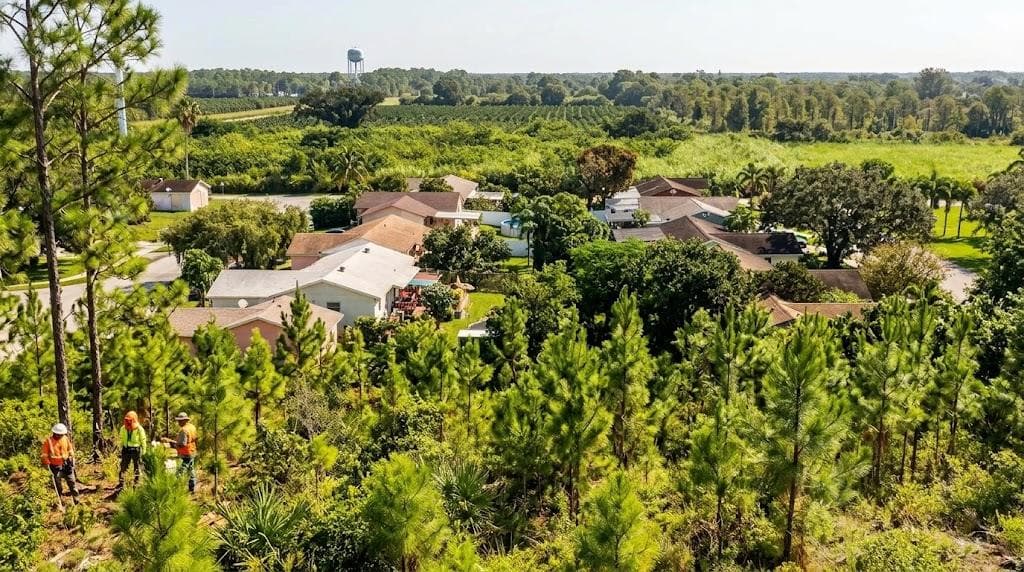
Neighborhoods and farmland rates in local planning: Municipal zoning authorities systematically approve boundary extensions for residential projects over former agricultural terrain, a trend visibly unfolding across Homestead neighborhoods within Miami-Dade County Miami-Dade County Planning Department.
-
Impact where Florida is trading forests for development: Environmental surveys document continuous land conversion patterns across multiple counties, highlighting how rapid real estate expansion systematically reduces native biological habitats and alters regional watersheds World Wildlife Fund.
Ver esta publicación en Instagram
Equally important, regional conservation groups track how Neighborhoods and farmland rates affect long-term ecological balance, expecting updated satellite imagery through 2025 to mark a crucial turning point for habitat preservation, since maintaining connected biological pathways remains vital for native wildlife survival; dynamically, environmental advocates urge local authorities to reverse the trajectory where Florida is trading forests to guarantee long-term ecological stability across the state National Audubon Society.
