

WATCH NOW
Watch on the app


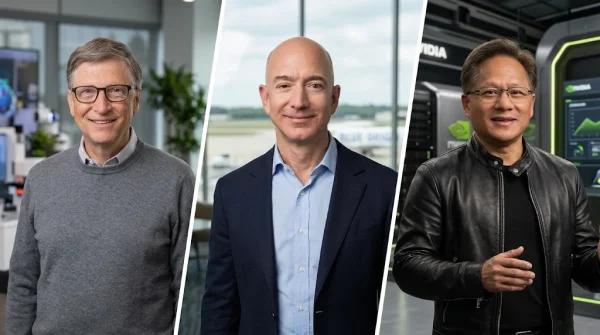











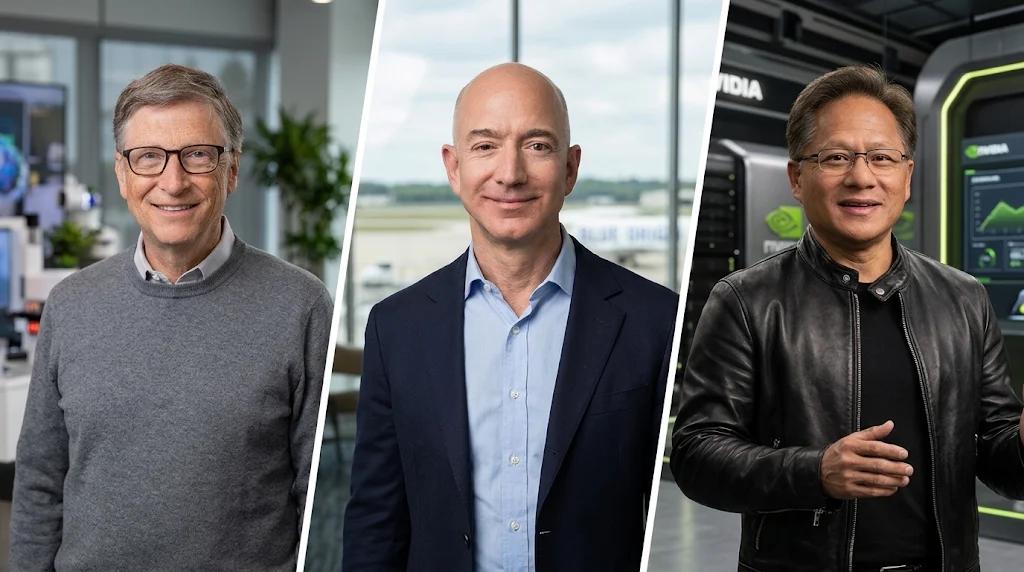
Bill Gates, Jeff Bezos and Jensen Huang show how cheating scandals can shake tech empires
-
Tech empires conduct formal corporate investigations into executive relationships to safeguard institutional leadership and shareholder value.
-
High profile cheating scandals involving technology founders trigger massive equity redistributions across global markets without altering operational executive authority.
-
Institutional technology giants balance executive stability against severe strategic asset risks and shareholder scrutiny.
Personal marital crises involving prominent industry leaders continuously challenge corporate stability, as high profile cheating scandals involving Bill Gates, Jeff Bezos and Jensen Huang demonstrate how private relationship breakdowns directly trigger corporate governance reviews and massive equity transfers; furthermore, while the specific financial outcomes varied significantly across each executive case, internal board inquiries and public asset disclosures consistently exposed corporate management structures to unprecedented shareholder scrutiny.
On the other hand, corporate governance experts continuously evaluate how personal conduct impacts long term organizational value; additionally, major institutional investors closely monitor executive board maneuvers to ensure that personal marital disputes do not jeopardize primary operational control or compromise proprietary technology disclosures within leading tech empires.
Corporate inquiry into Bill Gates and Microsoft board resignation
“There was an affair almost 20 years ago which ended amicably.”
In late 2019, a female engineer sent a formal letter to Microsoft board members alleging a prolonged intimate relationship with founder Bill Gates dating back to 2000, prompting the corporate board to hire an external law firm to conduct a comprehensive internal investigation; however, Gates resigned from his board seats at both Microsoft and Berkshire Hathaway in March 2020 before the firm concluded its inquiry. Following their formal separation announcement in May 2021 after 27 years of marriage, a spokesperson confirmed to The Wall Street Journal that an affair had occurred nearly 20 years prior, while media investigations by The New York Times detailed additional workplace invitations Gates extended to employees at Microsoft and his foundation, marking a major turning point in corporate executive oversight across prominent tech empires.
Furthermore, the couple finalized their divorce in August 2021 in King County, Washington, where they resided without a rigid prenup to divide their estimated $130B to $140B joint fortune, prompting Cascade Investment to transfer initial equity worth over $2.4B immediately after the announcement; consequently, Cascade executed subsequent public share transfers exceeding $6B in multiple major corporations, including Canadian National Railway, AutoNation, Coca-Cola FEMSA and Grupo Televisa, establishing Melinda’s net worth between $11B and $13B, which ultimately led to her May 2024 departure from the Gates Foundation with an additional $12.5B for Pivotal Ventures while Gates maintained core corporate voting control intact despite the surrounding circumstances.
Jeff Bezos Amazon equity split and voting rights agreement
“I want to thank everyone who has reached out with support and love. It means more than you know.”
Amazon founder Jeff Bezos and MacKenzie Scott announced the end of their 25 year marriage on January 9, 2019, shortly before media leaks from the National Enquirer revealed intimate text messages, travel itineraries and photos detailing an extramarital relationship between Bezos and former TV anchor Lauren Sanchez, an exposure that legal filings attributed to Michael Sanchez; subsequently, Bezos published a post on Medium accusing parent company American Media Inc. of extortion, protecting his public standing during the intense tabloid scrutiny.
Moreover, having married in 1993 prior to Amazon’s founding and residing in Washington state where laws consider marital assets shared property without a prenuptial agreement, the former couple reached a legal settlement on April 4, 2019, transferring a 25% share of joint Amazon stock valued at $38.3B to MacKenzie Scott; nevertheless, Bezos retained the remaining 75% of their combined holdings, worth approximately $110B or 12% of Amazon, along with 100% of the voting rights and full ownership of The Washington Post and Blue Origin, ensuring that despite transferring 19.7M shares and temporarily relinquishing his status as the world’s richest individual, executive governance across major tech empires remained unaltered.
Jensen Huang Nvidia risk assessment and ongoing investigation
“I was unfaithful to my wife. My actions hurt her and our children. There is no excuse for what I did.”
Nvidia board members initiated an independent internal investigation on November 8, 2026, into founder and Chief Executive Officer Jensen Huang following U.S. intelligence reports indicating that a foreign intelligence operation targeted him through an extramarital relationship with Chinese businesswoman Alice Huang, also known as Huang Le; furthermore, an internal draft message leaked by Axios confirmed Huang admitted to workplace misconduct, triggering immediate board reviews regarding operational security protocols.
In addition, further reports by The New York Times and Financial Times detailed her executive background at Megaspeed International and potential attempts to gather sensitive information on U.S. artificial intelligence chips; however, although Beijing rejected the spying allegations and the board stated that no evidence indicated compromise of commercial secrets or national security, an independent committee of outside directors continues reviewing the matter while Huang cooperates fully and remains CEO without a designated successor, supporting the inquiry as Nvidia prepares its November 17 quarterly earnings report targeting $108B in revenue, proving that board scrutinies into tech empires executive leadership remain critical to corporate governance.
Institutional impact and executive governance protocols in modern tech empires
Corporate governance experts emphasize that executive board evaluations extend beyond financial wealth distribution to prioritize structural stability and intellectual property security; furthermore, historical precedents demonstrate that institutional investors focus primarily on preserving voting rights and executive continuity during high level personal disruptions across leading tech empires.
Meanwhile, market analysts continue assessing how executive oversight frameworks evolve when personal conduct intersects with global strategic assets, confirming that corporate governance protocols ultimately determine how major tech institutions navigate market consequences of high profile cheating scandals.
