










Brooklyn collapse leaves families waiting for answers as rescuers battle rain and uncertainty
-
At least 8 people died and 19 others sustained injuries following a sudden structural failure, while rescuers battle rain and severe weather threats across New York City.
-
Traditional residential blocks face intense scrutiny after unexpected building collapses prompt immediate multi-agency emergency responses and rigorous safety audits.
-
Financial and community support networks mobilize rapidly to assist displaced families while municipal investigators examine historical zoning and excavation records.
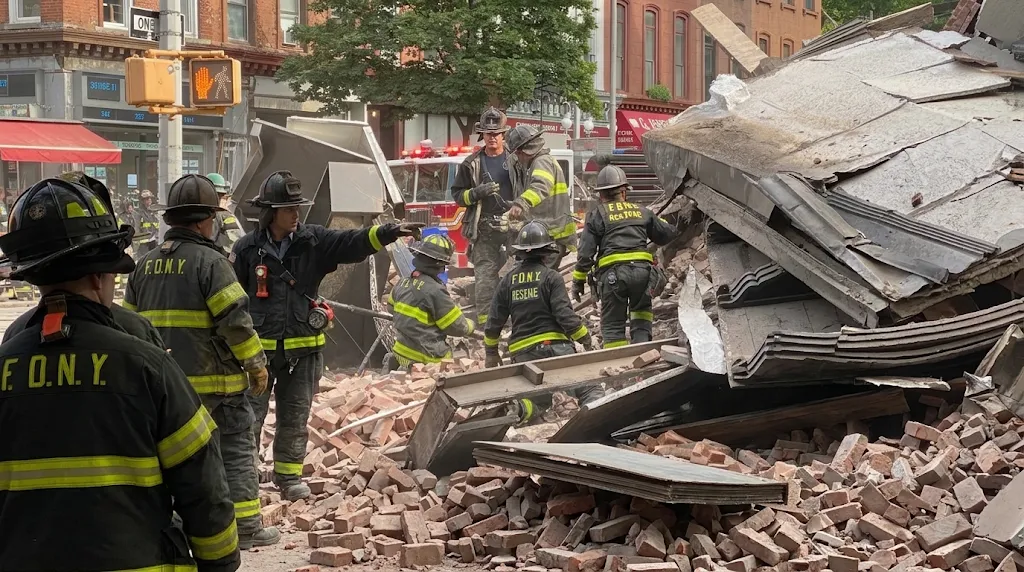
A Brooklyn collapse leaves families waiting for answers across New York City as four of the injured patients remain in critical condition and ten were transported with minor wounds following the sudden structural failure of a 3-story residential and commercial building built in 1930 at the intersection of Bedford and Flatbush avenues in the Flatbush neighborhood on Wednesday afternoon, according to official reports released by the New York City Fire Department. Furthermore, medical authorities confirm a precise breakdown where at least 8 people died and 19 others sustained injuries, while grieving relatives gather behind safety perimeters and rescuers battle rain and severe weather threats that include downpours and wind gusts reaching 50 km/h across the borough.
Moreover, municipal investigators examine whether prior unpermitted excavation work on an adjacent empty lot, where a demolition contractor previously paid US$ 10K in fines during October for violating stop-work orders, contributed to the tragedy, while Mayor Zohran Mamdani urges the community to keep the victims and their families in their thoughts. Additionally, FDNY Commissioner Lilian Bonsignore notes that at least 7 children figure among the affected victims, prompting city officials and the New York City Emergency Management office to establish an immediate Red Cross assistance center at the local YMCA for displaced residents.
Emergency response and multi-agency deployment during the Brooklyn collapse
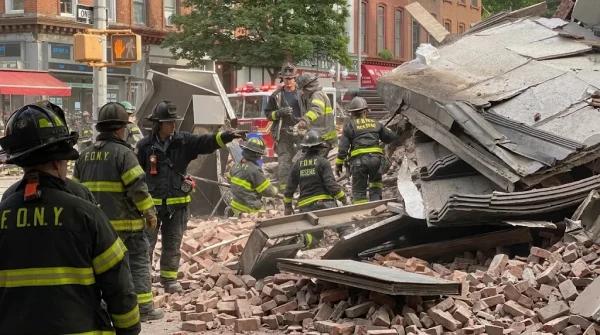
Deploying specialized extraction teams requires meticulous coordination among approximately 250 firefighters and medical personnel who tunnel through unstable concrete and twisted metal to reach survivors trapped in interior cavities and rescue units additionally utilize manual debris removal techniques, thermal imaging equipment and human chains that function like conveyor belts to transfer injured victims safely to waiting ambulances.
Furthermore, structural engineers closely monitor the partially standing adjacent building to prevent secondary collapses while heavy storm systems complicate ongoing rescue operations throughout the central borough as daylight fades, and municipal authorities review historical zoning records to determine liability while rescuers battle rain and extreme operational hazards in the disaster zone.
Moreover, as hours progress following the tragic incident, New York City authorities confirm that search operations remain active while specialized crews face adverse weather conditions in the Flatbush disaster zone and during an official briefing led by Mayor Zohran Mamdani alongside the Fire Department of New York, officials detailed that approximately 250 firefighters and rescue workers labor continuously utilizing heavy machinery and advanced technology to locate potential missing individuals, further reaffirming that the operation remains focused on rescue rather than recovery.
Critical challenges and ongoing weather impacts on operations
-
Severe storm warnings: Heavy rainfall and gusty winds reaching 50 km/h threaten to disrupt recovery operations through Friday across Brooklyn.
-
Massive personnel mobilization: Approximately 250 FDNY and emergency medical workers maintain continuous search rotations at the disaster zone.
-
Tragic casualty statistics: Official reports confirm 8 fatalities and 19 injuries, including 4 critical cases and 7 affected children.
-
Rescuers battle rain: Emergency crews maintain unwavering dedication despite adverse meteorological conditions while conducting the ongoing emergency investigation.
Community support and institutional outlook for affected residents
Establishing comprehensive relief networks remains a top priority for local agencies as displaced families receive shelter, counseling and material assistance at community support centers established by the New York City Emergency Management department in coordination with the American Red Cross at the Flatbush YMCA.
Meanwhile, resilient community members and local volunteers rally behind the victims by offering supplies and encouragement to exhausted first responders who maintain unwavering dedication despite punishing weather conditions and hazardous dust clouds, leaving city leaders determined to complete every phase of the recovery operation while supporting the community affected by the Brooklyn collapse.
