














Radiation, 10 days away from Earth and other real dangers the 4 astronauts traveling to the Moon will face
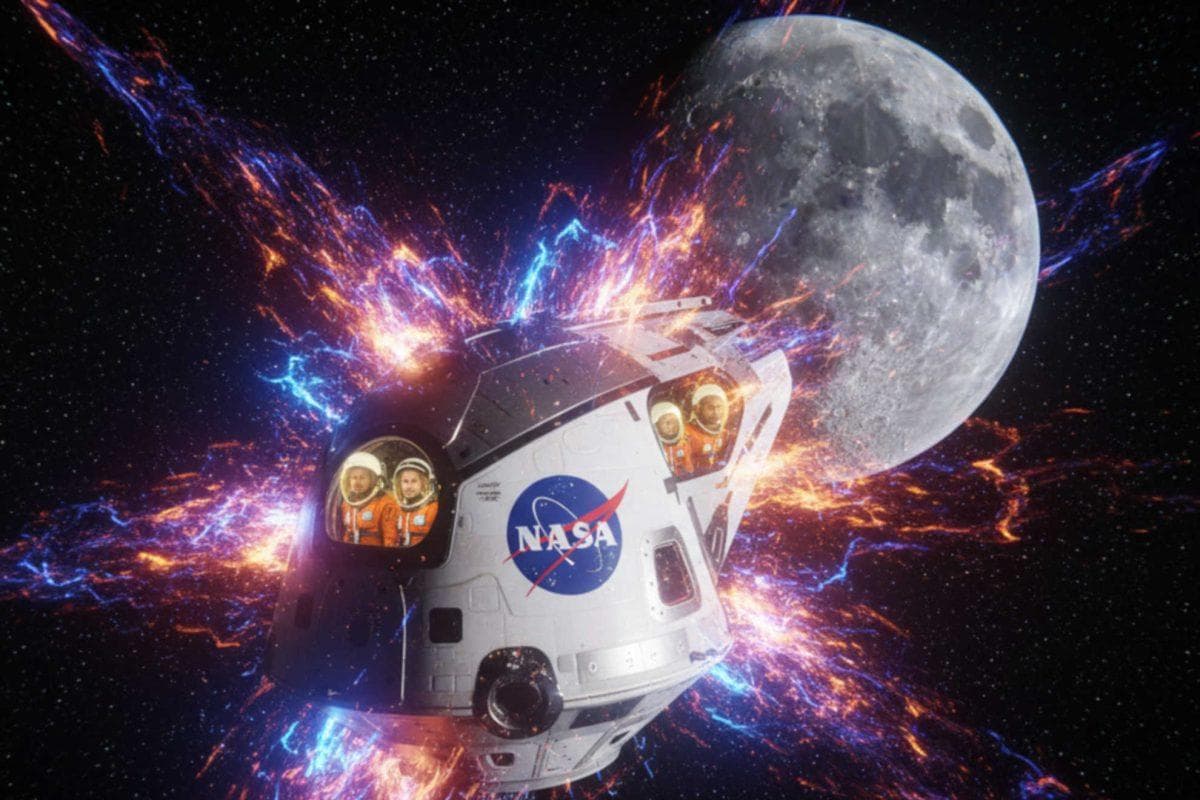
- The Artemis II mission will expose its crew to critical levels of solar radiation and galactic cosmic rays once they leave the protection of Earth’s magnetic field.
- Astronauts will face physiological challenges such as bone mass loss and potential DNA damage; furthermore, the Orion spacecraft will experience communication blackouts of up to 41 minutes when passing behind the Moon.
- The success of this ten-day journey is decisive for the safety of future moon landings, as it will test new solar storm shelters and protective vests designed for deep space.
Following the technical delay that pushed the schedule to March, the Artemis II mission fights not only against the clock but against invisible dangers that threaten the lives of its four crew members; in fact, this trip represents the first time humans will leave low Earth orbit since the Apollo era, remaining exposed to space radiation that the atmosphere of The United States and the rest of the world normally blocks. For the scientific community, the main risk lies in crossing the Van Allen belts and facing solar storms that could cause irreversible cellular damage; certainly, biological safety represents the greatest obstacle to human exploration of the solar system in this century. Every technical adjustment made during this extra time seeks to ensure that Reid Wiseman, Victor Glover, Christina Koch and Jeremy Hansen return home safely after defying the limits of human endurance.
The invisible enemy of deep space
Radiation stands as the number one biological challenge because, outside the magnetosphere, charged particles travel at speeds close to light and pass through matter easily; consequently, the astronauts of the Artemis II mission depend entirely on special shelters installed in the Orion capsule. Galactic cosmic rays can cause DNA mutations and increase the risk of cardiovascular diseases; likewise, the estimated exposure for this ten-day trip equals receiving a full-body CT scan in a single blow. Although engineers have developed vests that absorb up to 60% of radiation, protection against high-energy atomic nuclei remains limited and represents a constant concern for medical experts.
Isolation and communication failures
In addition to physical risks, the psychological environment inside the Orion spacecraft will be extreme due to prolonged isolation and the critical distance from our planet; therefore, the crew must prepare for total autonomy, especially during moments when the Moon blocks radio signals. Furthermore, the Artemis II mission will face communication silences of more than 40 minutes when the ship passes the far side of the satellite; in the same way, the effects of altered gravity and the lack of natural light can cause severe fatigue and emotional disorders that affect decision-making. Learning to manage these periods of absolute disconnection is vital for the success of missions aiming to establish a permanent human presence outside Earth.
Technical lessons for the lunar future
The recent analysis of the heat shield from previous missions forced NASA to modify the reentry trajectory to prevent material fragments from detaching dangerously; therefore, this flight will serve as a real-time laboratory to validate if these solutions suffice before attempting a landing in Artemis III. The technical challenges causing the current delay represent only the tip of the iceberg compared to the complexity of keeping vital systems running in the vacuum of space; nonetheless, the space agency trusts that these tests will define the course of space adventure for decades to come. The resilience of technology and the bravery of the crew are the pillars that will allow humanity to conquer the stars safely once again.
This trip is much more than a lap around the Moon; it is the ultimate test for our survival in deep space. If you want to learn more about how these modern heroes prepare for the unknown, stay tuned for every update on the Artemis II mission.
