

WATCH NOW
Watch on the app














The Latino astronaut helping lead NASA’s return to the Moon
-
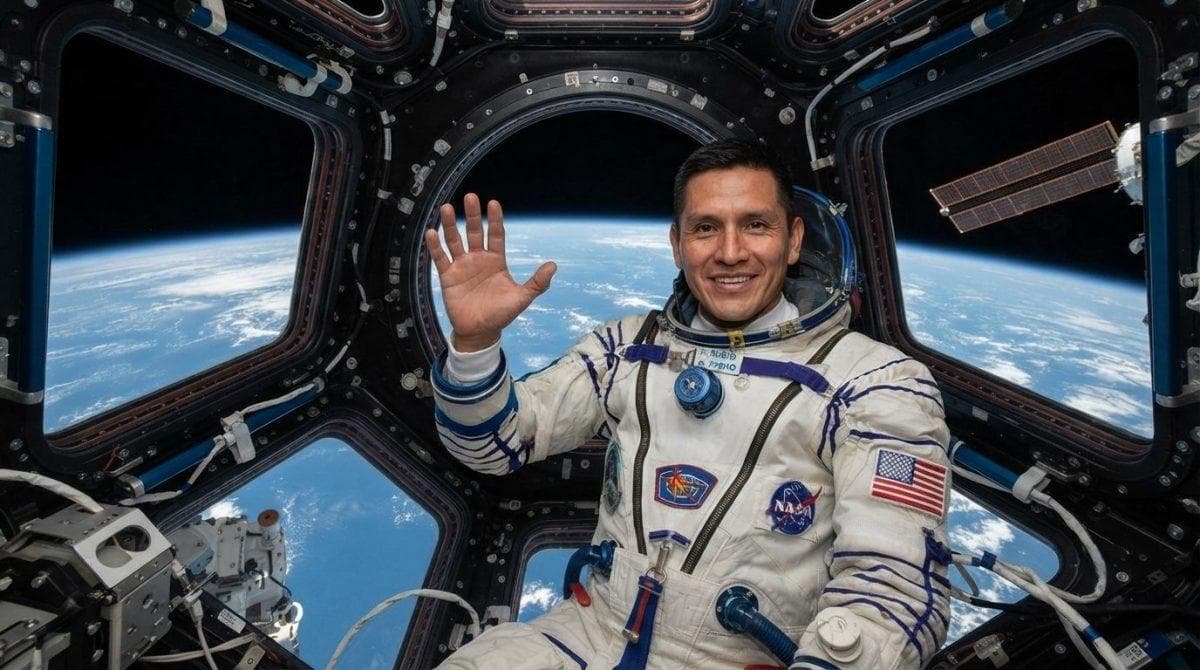
This latino space explorer sets a historic precedent for the American space agency by joining the primary crew designated for upcoming lunar journeys.
-
The Salvadoran-descent astronaut established a historical record of 371 continuous days in space aboard the International Space Station.
-
The selection responds to rigorous physical and mental performance criteria; consequently, government authorities prioritize profiles with military and medical experience to face the technical challenges of advanced orbital exploration.
Latino astronaut headlines international news when American Frank Rubio officially integrates as the only member of his background within the Artemis program of the American Space Agency; likewise, the professional’s trajectory includes a prolonged stay in the International Space Station complex that broke historical records for continuous permanence in weightless conditions, while this latino space explorer proves that discipline overcomes any adversity. The official designation occurred on American soil during, when aerospace authorities confirmed the crew destined to fulfill complex deep exploration missions; therefore, this strategic selection seeks to guarantee the technical success of upcoming lunar expeditions through the utilization of highly qualified and resilient profiles.
The accumulated experience during 371 days straight in space consolidates this specialist as an undisputed benchmark of resilience and scientific discipline; equally, the expert’s preparation encompasses rigorous military training and advanced studies in operative medicine, fundamental qualities to mitigate risks in prolonged missions. The international community watches this technological event with close attention, confirming that the diversity of talents strengthens high-performance teams; thus, the presence of the expert demonstrates that scientific perseverance opens new horizons for future generations of researchers throughout the American continent.
Trajectory of the latino astronaut in space missions
The expert’s career began long before entering aerospace agencies, standing out first as a helicopter pilot and military physician in complex operations; additionally, this comprehensive training granted him key competencies to withstand extreme conditions of physical and mental stress during his long months of orbital isolation, while this latino space explorer of Salvadoran descent assumes new institutional challenges. Official records from the American Space Agency detail that the professional completed hundreds of vital scientific experiments and numerous extravehicular spacewalks while orbiting Earth; consequently, the institution valued these technical credentials to assign him a central role in the preparations for sustainable lunar infrastructure.
Ver esta publicación en Instagram
The physical demands of the space environment require rigorous cardiovascular adaptation that few human beings manage to surpass without compromising long-term health; for this reason, the crew member’s training included advanced medical protocols and intensive simulations in high-technology centers located on North American soil. Aerospace medicine experts permanently monitor the physiological indicators of crew members to prevent muscular and skeletal deterioration derived from the lack of gravity; consequently, the results obtained from these evaluations serve as a scientific basis to design better sanitary countermeasures in future crewed flights toward Mars.
Ver esta publicación en Instagram
Technological innovation and lunar mission protocols
-
The ship’s infrastructure includes advanced life support systems developed through strategic alliances with private companies in the aerospace sector; on the other hand, engineers optimized control panels to allow rapid reading of flight parameters in real time and guarantee safety.
-
Operational protocols demand daily emergency drills to guarantee crew safety against possible mechanical failures in descent modules; similarly, specialists constantly practice docking maneuvers and the repair of critical components.
-
The program incorporates quantum communication technology to secure high-speed links between the lunar surface and ground control stations; concurrently, the technical team implemented automated navigation systems guided by artificial intelligence.
-
Energy reserves utilize high-efficiency solar cells designed to resist the extreme thermal variations of the space environment; for that reason, the mission possesses the necessary energy autonomy to operate for prolonged periods without depending on external supplies.
Daily activities aboard orbital stations demand millimeter-level coordination among the various international scientific departments involved in the project; asimismo, crew members must efficiently manage available resources of water, oxygen and dehydrated food to ensure the sustainability of the temporary habitat, while this latino space explorer spearheads the most complex tasks. Research developed in microgravity ranges from the experimental cultivation of plants to the analysis of cellular behavior in the absence of weight; therefore, Rubio’s work proves indispensable for deciphering how the human body reacts to prolonged environmental stressors and protecting the health of future crews.
Orbital operations
The planned return to Earth’s surface demands a controlled atmospheric reentry where the capsule withstands extreme temperatures due to friction with the upper layers of air; additionally, maritime and terrestrial rescue teams wait in predetermined zones to ensure immediate medical extraction of the astronauts after splashdown, while this latino space explorer oversees arrival protocols.
The gathering of biometric data collected during this process feeds the databases of the American Space Agency to refine the designs of future interplanetary transport vehicles; in this manner, each phase completed with success consolidates a definitive step toward the consolidation of sustainable human presence beyond Earth’s orbit through the constant leadership of latino astronaut.
