

WATCH NOW
Watch on the app














Texas cartels had to reverse smuggling routes into Mexico and now they make billions
-
Transnational criminal organizations are aggressively reconfiguring their logistics operations along the U.S.-Mexico border.
-
Fuel trafficking now causes annual losses exceeding $9 billion for the state.
-
U.S. federal authorities are ramping up sanctions against shell companies linked to illicit supply networks.
Texas cartels are radically transforming their business models by reversing traditional smuggling routes to move hydrocarbons from U.S. territory into Mexico; this strategic pivot allows groups like the Jalisco New Generation Cartel to leverage the region’s high refining capacity, bypassing border controls through tax evasion schemes widely known as “huachicol fiscal.”
Furthermore, these criminal groups consolidate a complex structure of intermediaries, corrupt customs brokers and front companies that forge documents to classify shipments as waste oil or unregulated chemicals; this tactic evades the Special Tax on Production and Services, granting these transnational criminal organizations a multimillion-dollar net profit margin as they sell the product at market price through gas stations under their control.
The mechanics of fuel trafficking
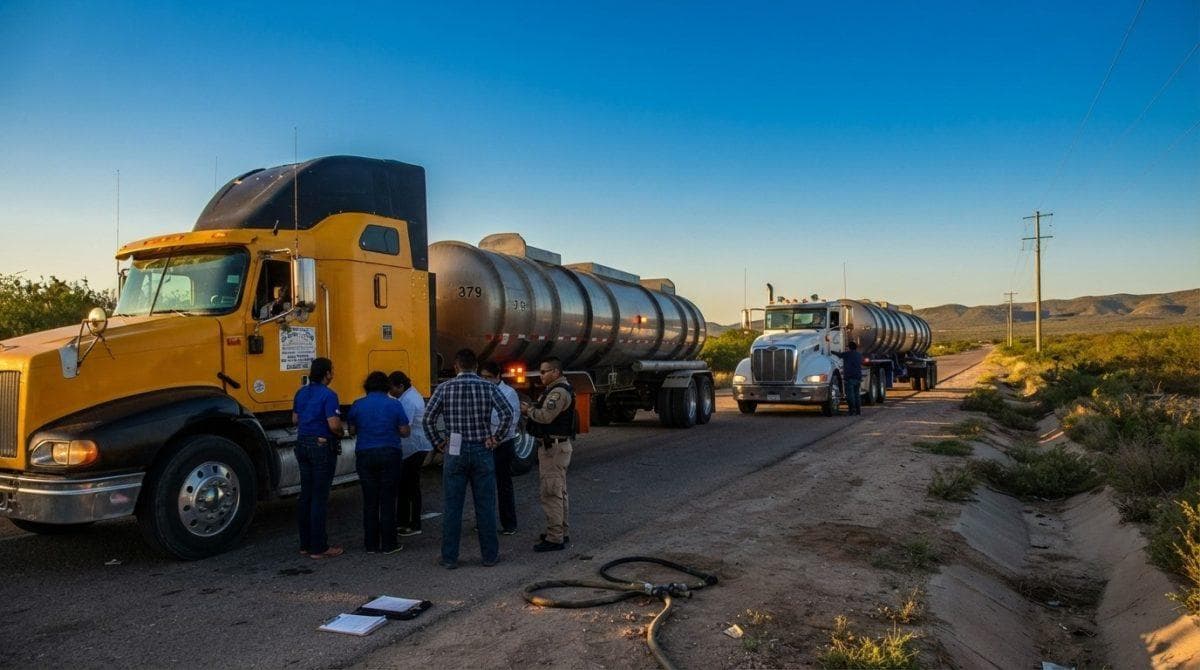
Smuggling gasoline involves buying diesel, naphtha and distillates legally in Texas before launching a systematic document forgery process at international crossings; logistics facilitators ensure that tanker trucks cross the border without raising suspicion among public officials, who accept bribes to permit the entry of merchandise that subsequently floods the Mexican market with untaxed products.
Likewise, data from the Financial Crimes Enforcement Network (FinCEN) underscores a troubling economic reality where one-third of the fuel sold in the neighboring country originates from illegal or adulterated sources; this criminal monopoly displaces legitimate distributors and destabilizes energy security while financial networks process more than $7 billion in suspicious activity reports linked to this fraud, managed by these transnational criminal organizations.
Consequently, the benefits obtained through this tax evasion finance the operational growth of organized crime and its territorial expansion; these earnings cover maintenance costs for the shadow fleet used for cross-border transport and bolster the acquisition of heavy weaponry, alongside the funding of other illicit activities that impact the security of both nations, allowing these transnational criminal organizations to operate with total impunity.
Indicators of the operational impact of Texas cartels
-
The smuggling scheme causes an annual loss of $9 billion in tax revenue for the Mexican government.
-
Financial institutions detect $7 billion in suspicious activity reports over the last twelve-month cycle.
-
One-third of all fuel sold in the local Mexican market has an illicit origin derived from these cross-border operations.
Subsequently, the Office of Foreign Assets Control (OFAC) imposes direct sanctions against citizens and corporations acting as logistics facilitators for these criminal groups; these measures dismantle the real estate and transport infrastructure that hides the origin of funds obtained through clandestine sales, making it harder for these transnational criminal organizations to reinvest their profits into the formal financial system.
Similarly, law enforcement agencies in South Texas monitor the constant flow of tanker trucks crossing the border under fraudulent legal cover; these investigations demonstrate that technological sophistication and access to financial networks allow these organizations to maintain global operations despite international pressure, evidencing an adaptability that forces a deep review of current customs protocols applied to these transnational criminal organizations.
Even so, the flow of illegal gasoline southward creates an operational dependency that authorities attempt to mitigate through interagency cooperation; the dismantling of front companies curbs criminal capacity, as every dollar evaded in taxes represents a resource siphoned from public coffers to strengthen armament power, thereby fueling the activities of these transnational criminal organizations.
National security implications
However, the use of the U.S. financial infrastructure to coordinate the movement of hydrocarbons presents a challenge without precedent for international intelligence; tracking barges and land fleets requires constant coordination among [enlace sospechoso eliminado] to prevent capital generated by “huachicol fiscal” from boosting drug trafficking, a common strategy among these transnational criminal organizations.
Dismantling this business model will restore the integrity of the binational energy market, as only a comprehensive offensive that suffocates these financial networks will effectively weaken the control currently exerted by the Texas cartels.
