

WATCH NOW
Watch on the app













San Andreas Fault can react after earthquakes hit thousands of miles away and scientists explain how
- Remote seismic triggering demonstrates how massive global earthquakes generate underground pressure changes in vulnerable fault zones.
-
San Andreas Fault acts as a critical geological boundary where distant seismic waves trigger tectonic stress across thousands of miles.
-
United States Geological Survey researchers closely monitor these deep tremor episodes within active plate transition boundaries.
San Andreas Fault experiences direct mechanical pressure when powerful earthquakes occur thousands of miles away because seismic waves travel globally to alter local underground stresses. Modern geophysics documents this interaction as remote seismic triggering, which acts as an external catalyst on fault systems already operating near their critical failure thresholds; meanwhile, specialists analyze how these energy pulses penetrate deep crustal layers to provoke micro-shocks across distant tectonic boundaries without necessarily causing immediate structural rupture.
During comprehensive field investigations conducted across central California by the USGS Earthquake Hazards Program, scientific teams recorded significant deep tremor activity within the Parkfield-Cholame transition zone following major global events. This phenomenon primarily affects regions characterized by high thermal activity or accumulated tectonic strain, proving that regional faults remain exceptionally sensitive to external energy influxes; moreover, researchers emphasize that understanding these interconnected systems helps evaluate long-term hazard levels along major plate margins.
Mechanics of remote seismic triggering
Crustal wave propagation reveals that global tectonic movements operate as an integrated network where distant energy release impacts localized fault structures under strict mechanical conditions. Furthermore, federal scientific institutions report that dynamic stress changes manifest more frequently within volcanic and geothermal provinces where baseline pressures approach saturation limits; similarly, experts at the Hawai’i Institute of Geophysics and Planetology warn that multi-fault rupture potential grows steadily as continuous geological stress accumulates over centuries.
On the other hand, incoming seismic waves from remote epicenters do not automatically discharge all historical tension locked within regional fault lines; however, seismologists maintain continuous sensor networks to track subtle ground deformations and evaluate overall tectonic stability; consequently, ongoing assessments confirm that the San Andreas Fault retains unprecedented accumulated stress levels demanding rigorous international scientific surveillance.
Ver esta publicación en Instagram
Recent seismic activity across Latin America
-
Venezuela: Two powerful earthquakes measuring 7.2 and 7.5 shook the northern part of the country on June 24, leaving a toll of more than 6,300 deaths and severe infrastructural destruction across multiple areas.

6,000 dead in Venezuela; fears echo San Andreas Fault potential.
-
Colombia: A magnitude 7.4 earthquake struck on August 10 with its epicenter in the Chocó department near San José del Palmar, resulting in at least 181 fatalities and widespread regional structural damage.

Colombia quake devastation serves as stark San Andreas Fault warning.
-
Mexico: A magnitude 7.3 earthquake occurred on July 17 in Chiapas approximately 58 kilometers southwest of Puerto Madero, which was also heavily felt in Panama and prompted preventative evacuations.
Geological factors and regional vulnerability
-
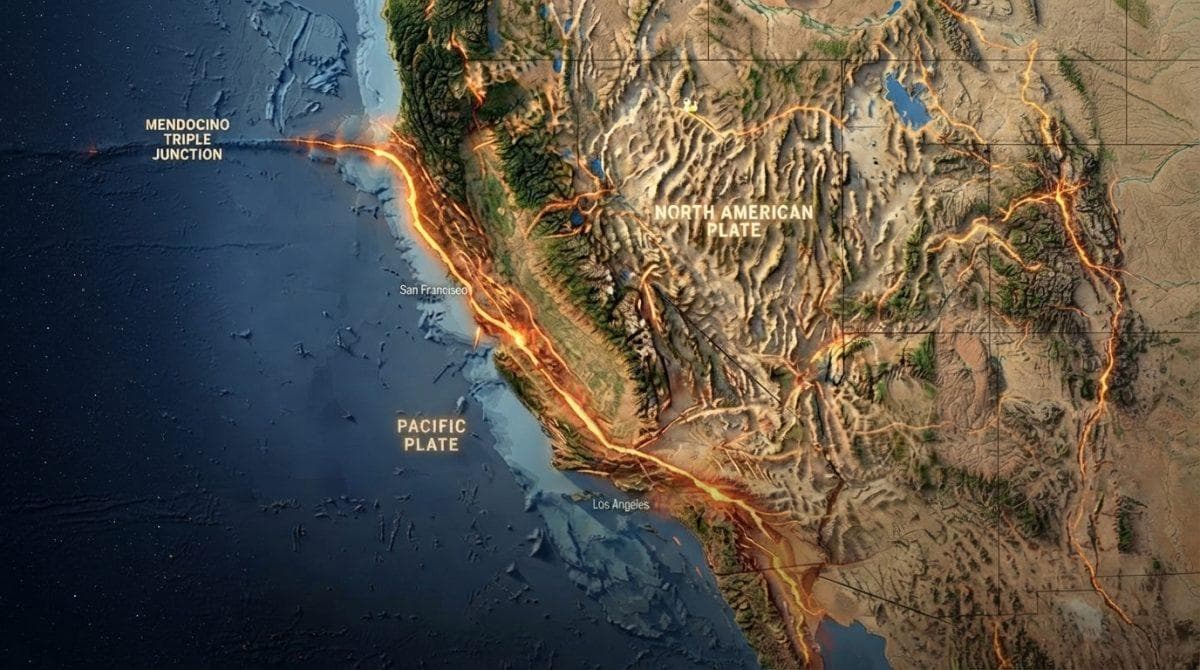
The extensive 1,200 km length of the San Andreas Fault defines the complex transform boundary between the Pacific plate and the North American plate.
-
Certain segments undergo smooth continuous creep while the southern section maintains a strict locking mechanism that exceeds 160 years of unreleased strain.
-
United States Geological Survey specialists document how passing seismic waves accelerate millimeter-scale deformation rates across sensitive fault compartments.
-
Metropolitan sectors surrounding Los Angeles and the Salton Sea concentrate the highest levels of stored tectonic energy accumulated over millennia.
-
Advanced borehole sensors and satellite radar measurements enable researchers to detect minute subsurface variations triggered by distant global temblors.
Remote seismic triggering highlights how geophysical assessments demonstrate that the Earth crust functions as a globally connected medium where dynamic energy transfers influence distant fault zones through specific mechanical interactions; thus, permanent technological surveillance continues shaping predictive models for the San Andreas Fault.
Ver esta publicación en Instagram
