

WATCH NOW
Watch on the app









Rare August sky will bring two celestial events here’s how to catch both
-
Rare astronomical alignments bring rare astronomical alignments to North America, while leading institutions prepare comprehensive observation schedules for stargazers.
-
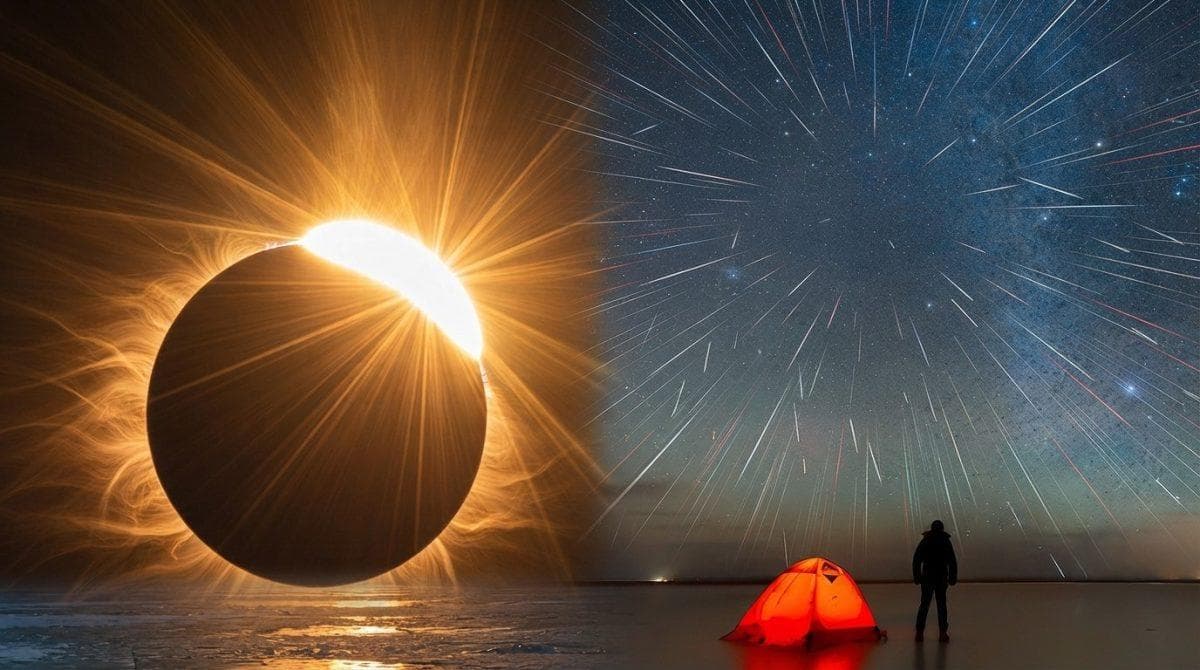
August celestial events offer a unique double feature on 8/12/2026 and residents across 27 states prepare to witness a partial solar eclipse alongside the peak of the Perseid meteor shower.
-
Various scientific agencies and digital platforms unite their tracking efforts to maximize public outreach and the astronomical community anticipates record engagement.
August celestial events captivate the United States when a rare overlap of a partial solar eclipse and the peak of the Perseid meteor shower arrives on 8/12/2026 and the National Aeronautics and Space Administration confirms optimal viewing windows across multiple regions. Consequently, specialized observatories coordinate public awareness campaigns to guarantee safe observation practices, meanwhile research teams analyze the unique orbital convergence and international science news outlets publish interactive maps and timing schedules to guide amateur astronomers through the cosmic spectacle, incorporating rare astronomical alignments into technical analyses.
Meanwhile, independent meteorological stations provide localized cloud-cover forecasts for the nocturnal peak and observers utilize dark-sky reserves to escape urban light pollution. Likewise, educational foundations distribute instructional guides to classrooms nationwide, inspiring students to explore planetary science and atmospheric physics, at the same time digital media platforms stream live telescope feeds for individuals located outside the direct viewing corridors.
Ver esta publicación en Instagram
Collaborative strategies for rare astronomical alignments
-
Observatory networks: Professional institutions share real-time tracking data across international stations to maximize analytical accuracy.
-
Public workshops: Universities organize weekend community seminars detailing safe solar and nocturnal observation protocols.
-
Digital broadcasts: Space agencies stream high-definition telescope feeds directly to online platforms for global audiences.
-
Equipment guides: Retailers publish certified specifications for beginner-friendly binoculars and portable tracking mounts.
-
Data archiving: Researchers compile multi-night photometric readings into open-access repositories for academic study.
As a result, research institutions coordinate global data-sharing protocols to enhance analytical precision after evaluating rare astronomical alignments and academic facilities host specialized symposiums examining deep-space telemetry findings. Equally, technological innovators design specialized smartphone applications that map planetary positions in real time, while software developers integrate augmented reality features for interactive celestial navigation and adding to this, educational foundations distribute printed star charts to community centers, ensuring that individuals lacking digital access can still participate in tracking the astronomical phenomena.
Regional visibility and essential safety guidelines
-
Alaska and Midwest visibility: Alaska, Illinois, Indiana, Iowa, Michigan, Minnesota, Montana, North Dakota, Ohio, South Dakota, and Wisconsin join the viewing corridor.
-
Northeastern observation zones: Connecticut, Delaware, District of Columbia, Kentucky, Maine, Maryland, Massachusetts, New Hampshire, New Jersey, New York, Pennsylvania, Rhode Island, Vermont, Virginia, and West Virginia participate.
-
Solar safety protocols: Experts mandate the strict use of certified ISO 12312-2 solar viewing glasses or specialized telescope filters to prevent severe retinal damage.
-
Dark-sky positioning: Authorities recommend traveling to rural parks and waiting at least 30 min in low-light environments to enhance meteor visibility.
-
Equipment guidelines: Observers must attach all optical solar filters securely to objective lenses rather than eyepieces to ensure complete visual safety.
Subsequently, astrophysicists examine planetary orbital variations to refine long-term gravitational models starting from rare astronomical alignments and space agencies publish comprehensive telemetry reports detailing atmospheric interactions. Similarly, specialized research grants fund university laboratories analyzing stellar radiation patterns, concurrently as international conferences host debates on recent cosmic discoveries and on another front, academic institutions evaluate the broader educational impacts of these public observation campaigns, documenting citizen participation metrics across digital media platforms while millions of gazes converge toward the firmament to redefine the future of modern astronomy with every August celestial events.
Ver esta publicación en Instagram
