

WATCH NOW
Watch on the app












New York job listings reveal why knowing your trade may no longer be enough

-
Knowing your trade no longer guarantees a stable job in the Big Apple, as the latest data reveals.
-
A Center for an Urban Future report shows that 44% of New York job listings demand digital skills even for manual trades.
-
Tech-required postings offer an average salary of $110K, outpacing traditional openings by over 25%.
The New York labor market undergoes a decisive shift because New York job listings demonstrate today why knowing your trade might no longer suffice for landing stable employment; additionally, the comprehensive study titled The Hidden Digital Skills Transforming New York City’s Labor Market, published by the Center for an Urban Future (CUF), reveals that 44% of posted vacancies across the metropolis demand verifiable digital abilities, completely reshaping access to occupations that historically served as gateway roles for immigrants and workers without college degrees.
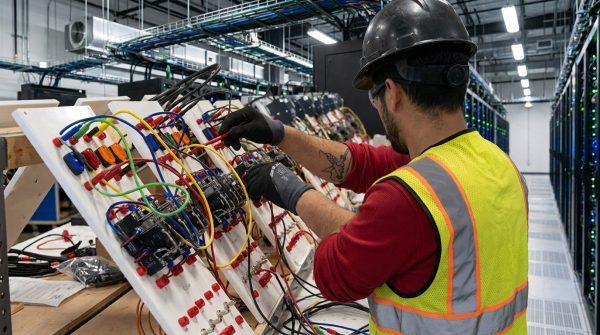
Furthermore, this research confirms that employers demand software and app proficiency across industries like construction, home care, transportation, warehousing and retail; consequently, full-time jobs requiring technology offered an average salary of $110K in 2025 compared to $87.9K for traditional positions, establishing a wage gap exceeding 25% throughout the entire city.
New York job listings and the digital surge in trade sectors
Expanding technology requirements outpace general urban employment growth because digital vacancies surged 40.3% between 2015 and 2025, quadrupling the overall expansion of job postings citywide.
Meanwhile, recognizing that knowing your trade proves insufficient against this backdrop, the analysis details how companies demand everyday mastery of shift-scheduling platforms, electronic record systems, productivity software and data analytics tools; similarly, sectors with high concentrations of high-school-educated workers lead this accelerated transition, where transportation and warehousing jumped from 33.6% in 2015 to 48.6% in 2025, while construction climbed from 32.5% to 43.5%, social assistance advanced from 30.4% to 41.9%, and retail escalated from 27.9% to 39.8%, forcing thousands of Latino, female and immigrant workers to master digital devices to protect their competitiveness.
Real barriers, artificial intelligence impact and knowing your trade challenges
-
Fernanda Castaño, a forty-seven-year-old Colombian resident in New York, exemplifies how knowing your trade in home care falls flat when applicants possess functional English but lack mobile app knowledge for clocking in, missing out on a position offering contracts, health benefits, and paid vacation that delayed her hiring by nearly five months.
-
Castaño’s brother faced an identical roadblock when trying to switch employers within the construction sector, confirming that companies demand basic tech literacy even for physical job sites.
-
Advanced tools capture ground rapidly because among the 1K most requested digital competencies in 2025, 14.8% were absent three years prior and 37.3% did not exist a decade ago, highlighting software like Power BI and Snowflake.
-
Artificial intelligence multiplied its footprint in New York hiring by appearing in 9.682K notices requesting generative AI, 1.673K New York job listings focusing on ChatGPT, and 1.308K vacancies centered on prompt engineering throughout 2025.
-
Jonathan Bowles, executive director of the CUF, maintained that what strikes observers as especially striking is how many jobs traditionally acting as entry points to the workforce now demand digital competencies that workers may never have had the chance to acquire.
Municipal response and technology training through CUNY
Eli Dvorkin, coauthor of the study and editorial and policy director for the CUF, urged Mayor Zohran Mamdani’s administration to roll out a renewed digital equity plan linking public investment with workforce development organizations.
Indeed, knowing that training in technological tools and artificial intelligence remains indispensable to bridge the gap between current skills and the real demands of local employers, the expert emphasized ongoing municipal partnerships, prompting City Hall to collaborate with City University of New York (CUNY) campuses across all five boroughs through the municipal artificial intelligence initiative named CUNY Tech Futures, where 80% of graduates remain within the metropolis to build their professional careers through institutions like John Jay College and City Tech, proving that combining practical training with digital mastery defines modern success across contemporary New York job listings.