

WATCH NOW
Watch on the app














Mathematician who warned about AI thinks he knows the exact date of ‘Doomsday’
-
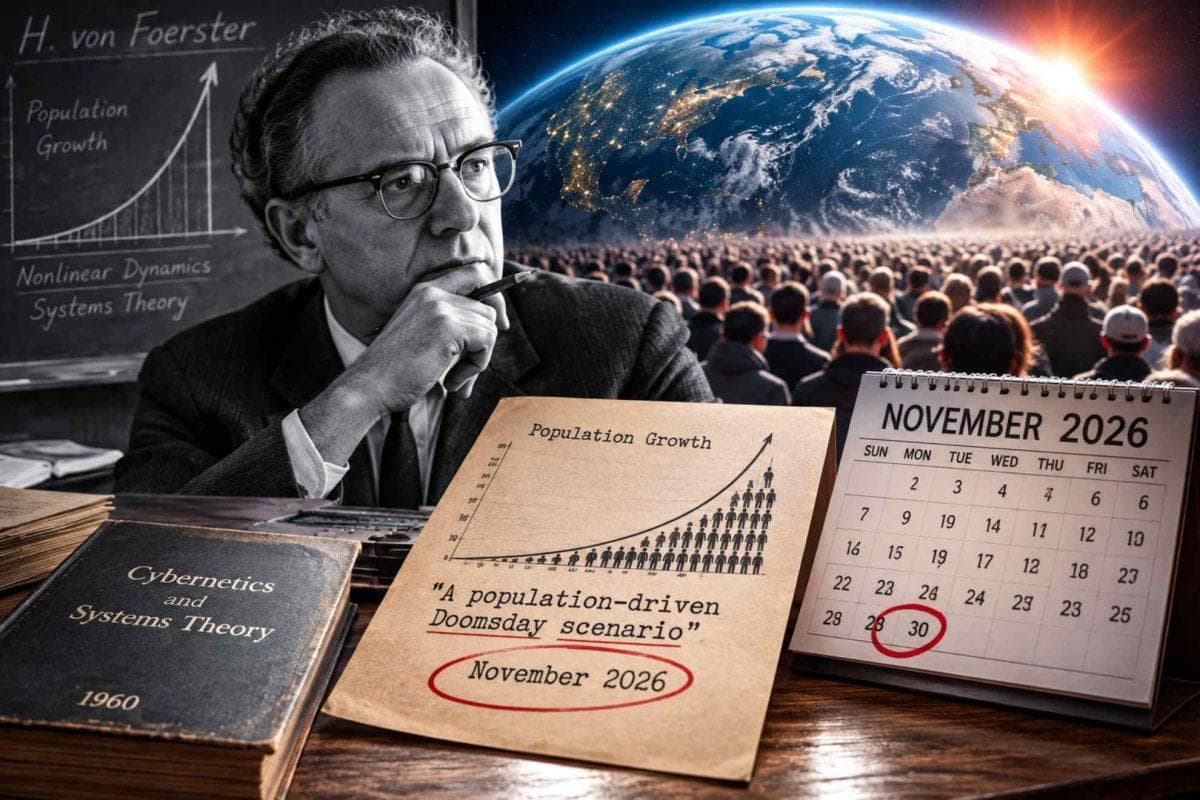
A 1960 scientific study published in Science magazine calculated the hypothetical end of civilization for Friday, November 13, 2026.
-
The research based its doom predictions on the exponential acceleration of human population growth and limited planetary capacity.
-
Coauthor Heinz von Foerster accurately foresaw decades ago the conceptual risks and dangers surrounding artificial intelligence.
A long forgotten academic study published in 1960 by the prestigious journal Science has resurfaced in public discourse after pinpointing an exact date for the collapse of human civilization. Authored by scientists Heinz von Foerster, Patricia M. Mora, and Lawrence W. Amiot from the University of Illinois, the research formulated a mathematical equation predicting humanity’s breaking point for Friday, November 13, 2026. While apocalyptic prophecies are common in popular culture, the rigorous mathematical foundation of this paper has reignited discussions regarding global population dynamics and resource limits.
Ver esta publicación en Instagram
Exponential population growth and environmental strain
The central premise of the hypothesis developed by the research team focused on the rapid expansion of the global population and its unsustainable strain on natural resources. When the study was originally released in the mid 20th century, Earth was inhabited by roughly 3 billion people, a figure that has since expanded past 8.3 billion. The authors argued that unlike traditional biological models where growth naturally slows due to immediate environmental boundaries, human technological adaptations would delay adjustments until a sharp, sudden systemic breakdown became unavoidable.
Ver esta publicación en Instagram
Early foresight on artificial intelligence risks
Public curiosity surrounding this historical prediction stems largely from the reputation of coauthor Heinz von Foerster, a distinguished Austrian American physicist and cyberneticist. Decades before automated digital tools became integrated into daily life, von Foerster demonstrated remarkable foresight regarding the societal risks of computing. During academic discussions in the 1990s, he warned that assuming artificial intelligence possesses human like thought processes simply because it executes complex tasks was a fundamentally dangerous misconception for humanity’s future.
Ver esta publicación en Instagram
Relevance of early warnings in modern society
Thirty years after his warnings about machine logic and mere weeks ahead of the date projected in his demographic study, von Foerster’s observations resonate strongly within contemporary debates. Modern societal reliance on algorithms, workplace automation and human like interactions with AI chatbots mirror the exact cognitive traps the researcher outlined. This verified accuracy in predicting human technology dynamics has prompted analysts to revisit his mathematical formulations concerning the physical limitations of the planet.
Ver esta publicación en Instagram
Modern demographic models vs historical predictions
Despite the anxiety surrounding the approaching deadline calculated in the study, current international demographic projections contrast with the 1960 mathematical model. Updated studies from the United Nations indicate that the global population is unlikely to experience a sudden collapse in the immediate future, instead projecting a peak of approximately 10.3 billion people during the 2080s before entering a gradual decline. Driven by agricultural innovations and changing global birth rates, human society has managed to navigate past the precise breaking point calculated by the team over six decades ago.
Ver esta publicación en Instagram
