

WATCH NOW
Watch on the app















NASA identifies the lunar eclipse expected to be the century’s most spectacular
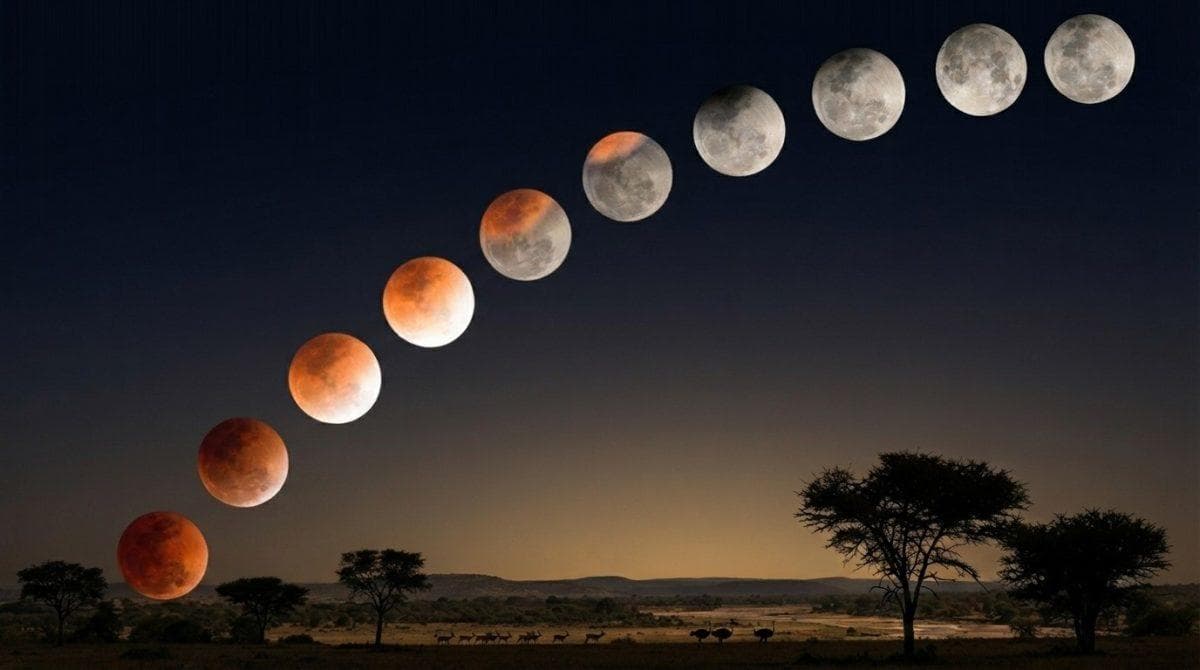
• A striking red moon will illuminate the skies across much of the planet during the night of June 25 to 26, 2029, offering an unprecedented visual spectacle for millions of people.
• The U.S. space agency confirms that this astronomical phenomenon will reach an impressive threshold magnitude of 1.84, becoming the deepest and most intense event of the entire 21st century.
• Observers throughout North America will enjoy an exceptionally prolonged totality phase lasting exactly 1 hr and 42 min without requiring any telescopes.
Lunar eclipse will captivate millions of observers across the Americas, Europe, Africa and western Asia during the night of June 25 to 26, 2029, according to a report by NASA, cementing the most impactful astronomical event of the 21st century thanks to a record threshold magnitude of 1.84 and furthermore, this celestial occurrence will allow the Moon to plunge deep into Earth’s shadow known as the umbra, generating a remarkably dark and intense hue of the red moon that will visually surpass any past event, which is why space enthusiasts are already preparing their equipment to record every detail of this historic planetary alignment.
Likewise, scientific experts explain that visibility across the United States will vary according to the corresponding time zone, placing the peak moment starting at 11:22 p.m. Eastern Time, 10:22 p.m. Central Time, 9:22 p.m. Mountain Time and 8:22 p.m. Pacific Time on June 25, while astronomers remind the public through data from Space.com that since this is a cosmic event no person will require specialized eye protection or costly telescopes to enjoy it directly with the naked eye, suggesting instead searching for areas far away from urban light pollution to appreciate with total clarity the radiant red moon.
Scientific details and atmospheric mechanics
During the progression of this celestial occurrence, Earth’s atmosphere will fulfill a fundamental role by acting as a physical filter that scatters blue light and allows only the wavelengths of the red moon to reach the lunar surface and consequently, the international scientific community will gather valuable data regarding atmospheric interaction and solar radiation during the totality phase that will extend for exactly 1 hr and 42 min, although local weather conditions could influence the direct visibility of the phenomenon, which is why meteorologists utilizing tools from the National Weather Service will constantly monitor the climatic patterns of the regions enabled for optimal observation.
Additionally, space physics specialists explain that a threshold magnitude of 1.84 represents the highest value registered in the entire current century, demonstrating the depth with which the natural satellite will penetrate Earth’s shadow cone, while educational institutions and scientific outreach centers will drive special programs to educate the public about the physical laws governing orbital movement and shadow projection in the solar system, turning this event into a key driver to foster interest in science among new generations of students as the designated date approaches.
Equally, the international community of amateur and professional observers will coordinate global astrophotography campaigns to document the gradual chromatic change the satellite will experience during the key hours of dawn, remembering that these types of geometric alignments occur due to the precise tilt of the lunar orbit relative to the ecliptic plane, a mathematical detail that rules out any anomaly in the habitual celestial cycle and therefore, the rigorous technical analysis backed by NASA Science will guarantee that the global population experiences a perfectly predictable and secure visual spectacle the lunar eclipse.
Ver esta publicación en Instagram
Global observation guides for the lunar eclipse
-
Residents along the U.S. East Coast will enjoy the peak of the event starting at 11:22 p.m. on June 25, 2029.
-
Viewers situated in the Central time zone will appreciate the celestial phenomenon starting at 10:22 p.m. during the same nocturnal schedule.
-
Communities located under the Mountain time zone will visualize the peak phase at exactly 9:22 p.m. local time.
-
Residents in the Pacific region will contemplate the splendor of the red moon starting sharply at 8:22 p.m.
-
Enthusiasts across Europe, Africa and western Asia will share the same temporal window adapted to their respective terrestrial meridians.
-
Experts suggest planning trips toward National Park Service locations or rural zones to escape the artificial light pollution of major cities.
-
Interested families will organize outdoor collective observations given that they will not require any type of specialized optical instrument.
Concurrently, meteorological portals will issue special bulletins during the preceding days to alert about potential cloud cover that might hinder the direct view of the satellite in certain geographic zones of the North American continent, prompting educators to seize this opportunity to introduce basic concepts of optical physics and elementary astronomy within basic and middle-level school classrooms, through which the cooperation between space agencies and mass media outlets will guarantee that no citizen misses the technical details of this astronomical gathering.
Cultural impact and scientific legacy of a red moon
Throughout human history, total eclipses have inspired myths, legends and advanced mathematical studies that allowed scientists to calculate with millimeter precision the tridimensional geometry of our solar system, reinforcing the official confirmation issued by NASA regarding public trust in modern scientific prediction methods, while research institutions will harness the temporary darkness of the satellite to measure radiation and extreme thermal changes that the lunar surface will suffer upon being deprived of direct solar radiation for more than 1 hr, consolidating an invaluable academic legacy for future generations of astrofísicos.
Meanwhile, the optical technology and digital photography industry anticipates a historic surge in the sale of specialized equipment to capture high-resolution images of the nocturnal firmament, with the global economy associated with astronomical tourism experiencing unprecedented dynamism, prompting international agencies to coordinate high-definition broadcasts that will allow millions of mobility-impaired individuals to enjoy the red moon from their homes in real time, paving the way for a memorable stellar journey that will forever mark the annals of contemporary science with this breathtaking lunar eclipse.
