

WATCH NOW
Watch on the app














El Niño is getting stronger and millions of Americans could feel the effects this winter
-
Winter weather patterns across the equatorial Pacific prompt federal agencies to monitor seasonal climate changes affecting vulnerable communities.
-
Federal climate experts confirm that rising ocean temperatures exceed normal thresholds, signaling an intensification phase that directly influences global atmospheric circulation.
-
Atmospheric specialists emphasize that recurring climatic cycles require careful adaptation across vulnerable regions, particularly as seasonal precipitation probability increases significantly.
El Niño is gaining strength across the equatorial Pacific, maintaining active alerts across federal climate agencies because ocean surface anomalies surpassed 7 °F while winter weather patterns shift rapidly; furthermore, atmospheric experts explain that this oceanic behavior directly alters heat and moisture exchange with the atmosphere, modifying dominant winds and large-scale precipitation zones without using a transitional adverb at the start of this secondary sentence.
Additionally, scientific models project an 83% probability that the phenomenon will maintain strong intensity during the boreal winter quarter, compelling authorities to intensify operational surveillance and likewise, the World Meteorological Organization warns that this specific warming overlaps with a general trend of elevated global temperatures, configuring a challenging meteorological outlook for the upcoming months.
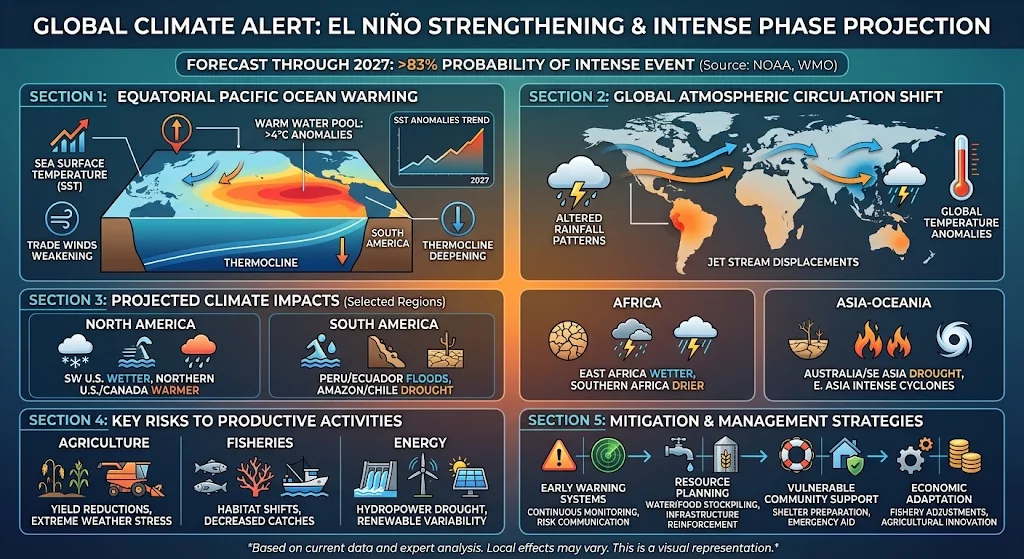
This complete infographic shows the NOAA and WMO projections, which estimate an 83% chance of an intense phase until 2027.
Winter weather patterns and Pacific circulation
Extensive oceanic shifts modify the fundamental dynamics of marine surfaces when the central ocean records above-average temperatures for several consecutive months, establishing environments where unusual marine species adapt to thermal variations, while trade winds that typically blow from east to west gradually lose strength, allowing massive warm water masses to shift toward the eastern continental shelf.
Consequently, this dynamic reduces the upwelling of deep, cold waters off South American coasts, diminishing phytoplankton availability and disrupting the marine food chain; however, the scientific community emphasizes that each episode presents regional particularities, avoiding the automatic attribution of all extreme weather events exclusively to this natural cycle while tracking 4 °C anomalies across tropical zones, proving how winter weather patterns evolve as El Niño is gaining strength.
Analyzing how El Niño is gaining strength across ocean basins
Meteorological forecasting models indicate that the expansion of warm waters displaces the Pacific jet stream, a high-altitude wind band directing storm tracks across thousands of feet of elevation and specialized services anticipate a higher probability of above-average precipitation in the American Southwest during the colder months of the year, providing unexpected biological adjustments for coastal habitats.
Similarly, residential zones built across millions of square feet of coastal terrain face elevated risks of heavy rainfall and sudden flooding, demanding proactive plans in local water management, while agricultural and energy sectors across multiple territories continuously analyze seasonal updates to mitigate potential economic impacts derived from these climatic alterations, ensuring that local water management remains fully operational while winter weather patterns persist.
Essential monitoring and operational strategies
Institutional protocols require governmental agencies to coordinate advanced observation methodologies for isolating background global warming from specific dynamics, establishing reliable baselines across participating regions.
-
The use of the Relative Oceanic Niño Index allows scientists to isolate precise thermal signals in the central Pacific without interference from accumulated global trends while El Niño is gaining strength.
-
Risk management committees establish emergency protocols facing the forecasted increase in seasonal precipitation across continental territory, monitoring how marine ecosystems migrate during winter weather patterns.
-
Scientific research centers weekly update oceanographic data to evaluate the exact evolution of marine surface temperatures, maintaining a 98.5% confidence rating for annual climate projections.
-
Local authorities promote informative campaigns designed to prepare vulnerable communities against extreme seasonal fluctuations, successfully securing long-term regional stability alongside El Niño is gaining strength.
