

WATCH NOW
Watch on the app














A hidden prehistoric giant emerged from the mud in Thailand and changed what scientists knew about Asian dinosaurs
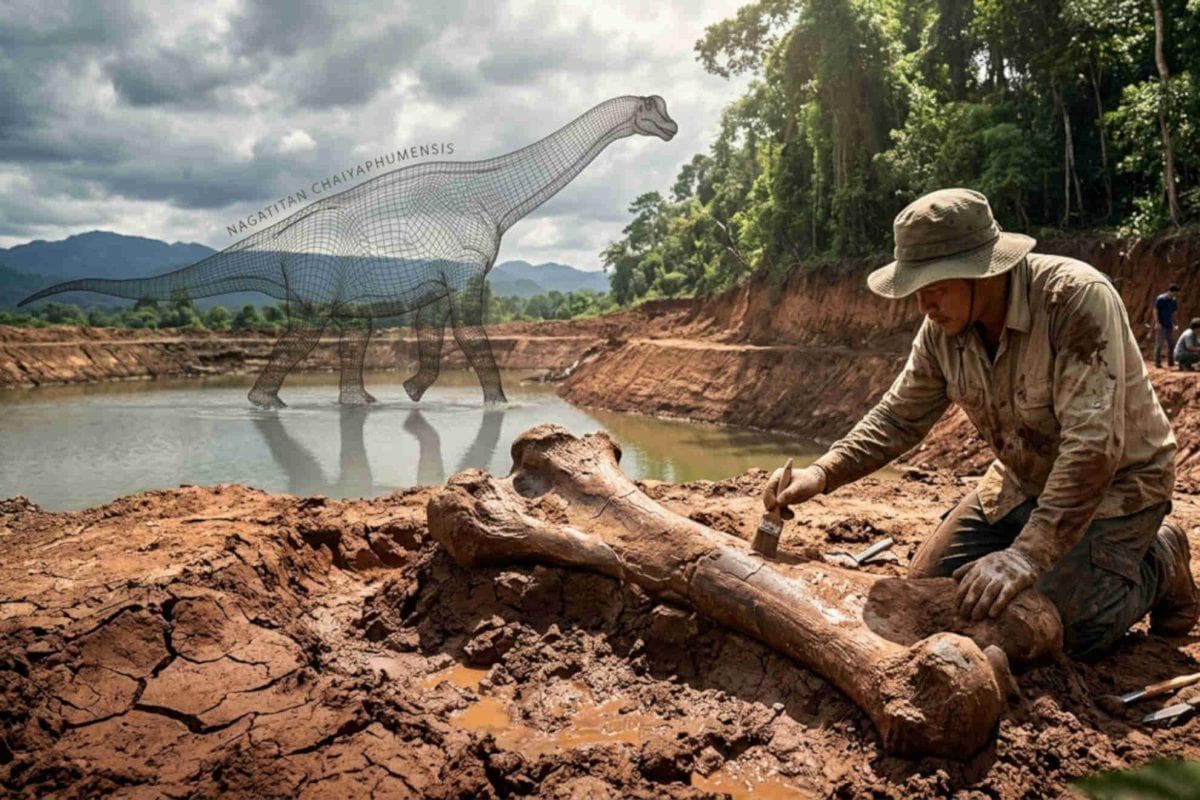
- The discovery of Nagatitan in Thailand occurred accidentally when a resident spotted giant bones emerging from the mud on the edge of a pond.
- With a weight equivalent to nine elephants, Nagatitan belongs to an exclusive Asian lineage that evolved in isolation during the Cretaceous.
- Scientists confirmed that giants like the Nagatitan in Thailand exceed other previously known sauropods in the entire Asian region by more than 10 tons.
Northeastern Thailand is now the epicenter of a paleontological revolution following the fortuitous discovery of Nagatitan chaiyaphumensis, a colossal creature that inhabited the Earth more than 100 million years ago. This giant long-necked dinosaur was identified by an international team of researchers after a local resident found massive skeletal remains during a drought season; consequently, the analysis of the recovered vertebrae and limbs allowed experts to determine that this animal measured an impressive 27 meters in length.
For prehistory enthusiasts in The United States and around the world, this discovery of Nagatitan in Thailand is crucial because it proves the existence of a unique evolutionary lineage known as Euhelopodidae, which thrived independently due to the geographic barriers of the era. The magnitude of the dinosaur specimen, which weighed up to 28 tons, challenges previous theories regarding the maximum size reached by herbivores in Southeast Asia during the mid-Cretaceous period.
The mystery of the pond and evolution in isolation
On the other hand, excavations conducted between 2016 and 2024 in the province of Chaiyaphum allowed for the rescue of key skeletal pieces of this specimen type, including a nearly complete femur and a humerus almost two meters long that confirm the massive scale of Nagatitan in Thailand. Furthermore, scientists explain that this dinosaur developed singular anatomical characteristics, such as specific bony wedges in its vertebrae, which clearly differentiate it from its South American relatives like Patagotitan or Argentinosaurus.
In this sense, it remains fascinating to observe how the extreme climate and high temperatures of 125 million years ago favored the excessive growth of these giants, allowing Nagatitan to position itself as the undisputed king of its ecosystem in Southeast Asia. By studying the evolutionary matrix of more than 150 dinosaur species, experts concluded that this animal is not closely related to other local sauropods, which suggests a much richer biological diversity than originally thought in the Khok Kruat Formation.
A milestone for Southeast Asian paleontology
Although Thailand has only conducted systematic research in this field for four decades, the identification of Nagatitan brings the number of named dinosaur species in the country to 14, consolidating it as a Southeast Asian powerhouse in fossil diversity. Likewise, international experts point out that, unlike species such as Diplodocus that fed at ground level, these titanosauriforms possessed necks designed to reach the highest vegetation thanks to their oblique posture.
In The United States, where large sauropods are cultural icons, this discovery highlights the importance of Asia as an evolutionary laboratory where dinosaurs adapted to an environment surrounded by an inland sea that limited contact with other continents. While excavation teams continue working in the area, the Sirindhorn Museum expects to receive new specimens that will continue rewriting the history of these colossi that dominated the Asian landscape before the great extinction.
